LambdaTest (TestMu AI) vs Sauce Labs: Pricing, Coverage, AI Agents
LambdaTest is now TestMu AI, and both grids now sell an AI test agent. Compare pricing, device coverage, analytics, and who can actually buy each agent.

You can buy LambdaTest’s AI test agent tonight with a credit card. Sauce Labs includes its agents only in an enterprise contract. Both companies rebuilt their pitch around AI this year, and that one difference says more about each of them than a device count does.
The bad news comes first. Under the new branding, both remain grids, and they’ve converged on price where it hurts most, real-device automation. Choose between them on access, coverage, and analytics. Just don’t expect either agent to decide what your app needs tested. It starts from what your team hands it, one test at a time.
What you’ll learn
- Why LambdaTest and TestMu AI are the same product, and what changed with the name
- Tier-by-tier pricing, device coverage, and analytics for both grids
- How KaneAI and Sauce AI differ on access, inputs, and UI changes
- Which tool fits which bottleneck, including the one no grid touches
LambdaTest or Sauce Labs? Start With Who Is Buying
TestMu AI is LambdaTest. The company rebranded on January 12, 2026 to lead with AI, and the grid, KaneAI, and HyperExecute carried on under the new name. Both names in your search lead to the same product.
Between the two, TestMu AI is the stronger default for self-serve teams that want the widest matrix at the lowest entry price. Sauce Labs is the stronger fit for enterprise buyers running Selenium or Appium at volume who want analytics and governance in the same contract.
| If you care most about… | Lean TestMu AI (LambdaTest) | Lean Sauce Labs |
|---|---|---|
| Entry price | Virtual Live from $15/month | Live Testing from $39/month |
| Published device breadth | 3,000+ browser combinations, 10,000+ real devices | Real devices plus a virtual cloud of emulators and simulators |
| Buying the AI agent | KaneAI, self-serve from $17/month | Sauce AI, included with Enterprise plans only |
| Selenium and Appium lineage | Full support, not its origin | Co-founded by Selenium’s creator |
| Cross-run analytics | Insights dashboards, execution-focused | Sauce AI for Insights, enterprise-focused |
Both are grids first. Each now sells an AI agent on top, and the way you buy that agent is the sharpest line between them.
What Each Vendor Sells in 2026
TestMu AI (Formerly LambdaTest)
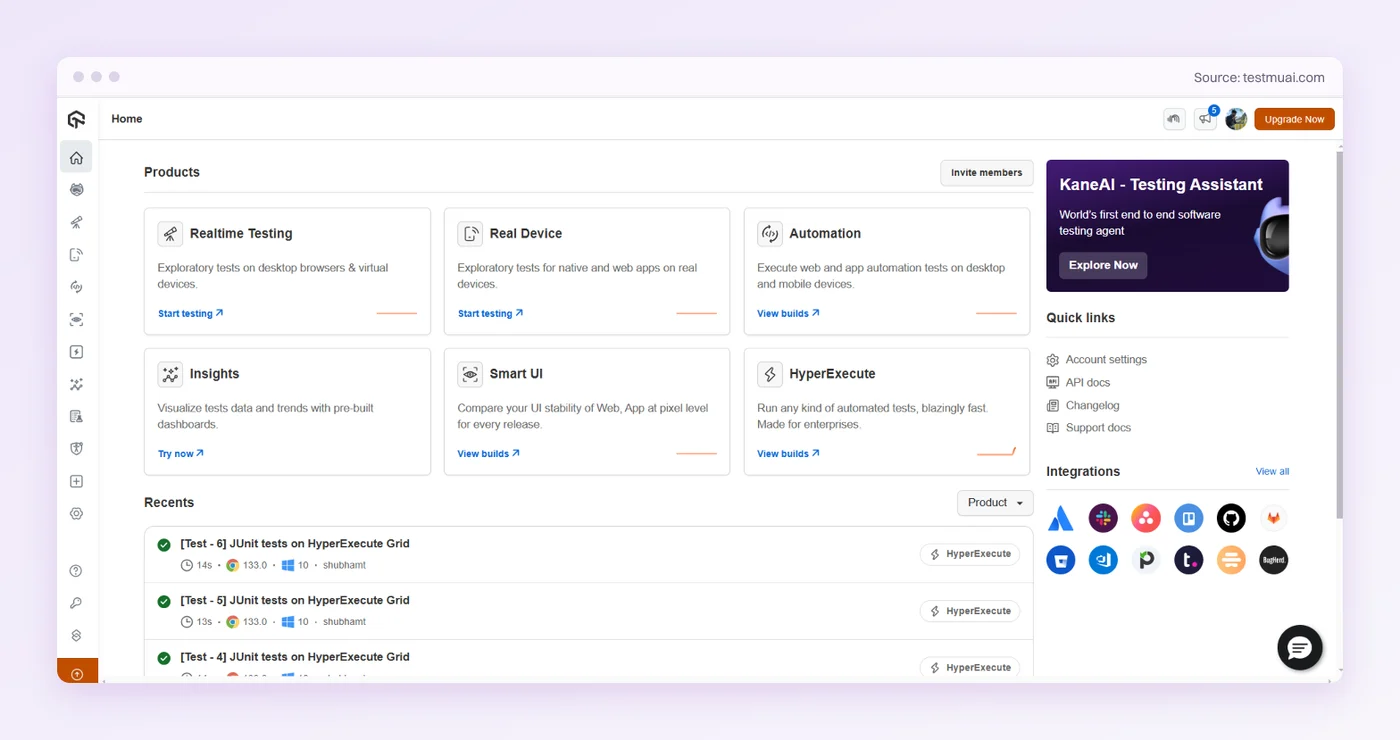
TestMu AI earns its place as the grid you can buy without talking to anyone. It advertises 3,000+ browser combinations and 10,000+ real devices, and nearly every tier below enterprise has a buy button. Since the rename, the pitch leads with KaneAI, its test-writing agent, while the device cloud underneath carries on unchanged.
Rating: 4.6/5 from 547 reviews on Capterra, as of September 2026.
Key features:
- Device cloud: 3,000+ browser and OS combinations and 10,000+ real Android and iOS devices, reachable self-serve.
- KaneAI: Builds tests from plain English, recorded sessions, Jira tickets, or a pull request comment, and exports Selenium, Playwright, Cypress, or Appium code.
- HyperExecute: TestMu’s orchestration engine for running large automated suites, priced as its own plan.
Pros:
- Low entry price: The cheapest way into either grid, with no procurement cycle.
- Agent on a card: KaneAI is available on self-serve plans, so a small team can trial it this week.
Cons:
- Device availability: Reviewers report real devices that show as available but fail to start or drop mid-session, newer iPhones at peak hours in particular.
- Cost past entry: Smaller teams find parallel sessions and advanced features expensive once they move beyond the entry tiers.
Pricing: Virtual Live from $15/month, Real Device Plus Automation Cloud at $199/month, and KaneAI from $17/month, all billed annually on the TestMu AI pricing page. Enterprise plans are quote-based.
Best for: Teams that want the broadest self-serve coverage at the lowest entry price, and want to try an AI agent without a contract.
Not for: Enterprises that expect deep cross-run analytics and a private device cloud bundled into one negotiated plan.
Sauce Labs
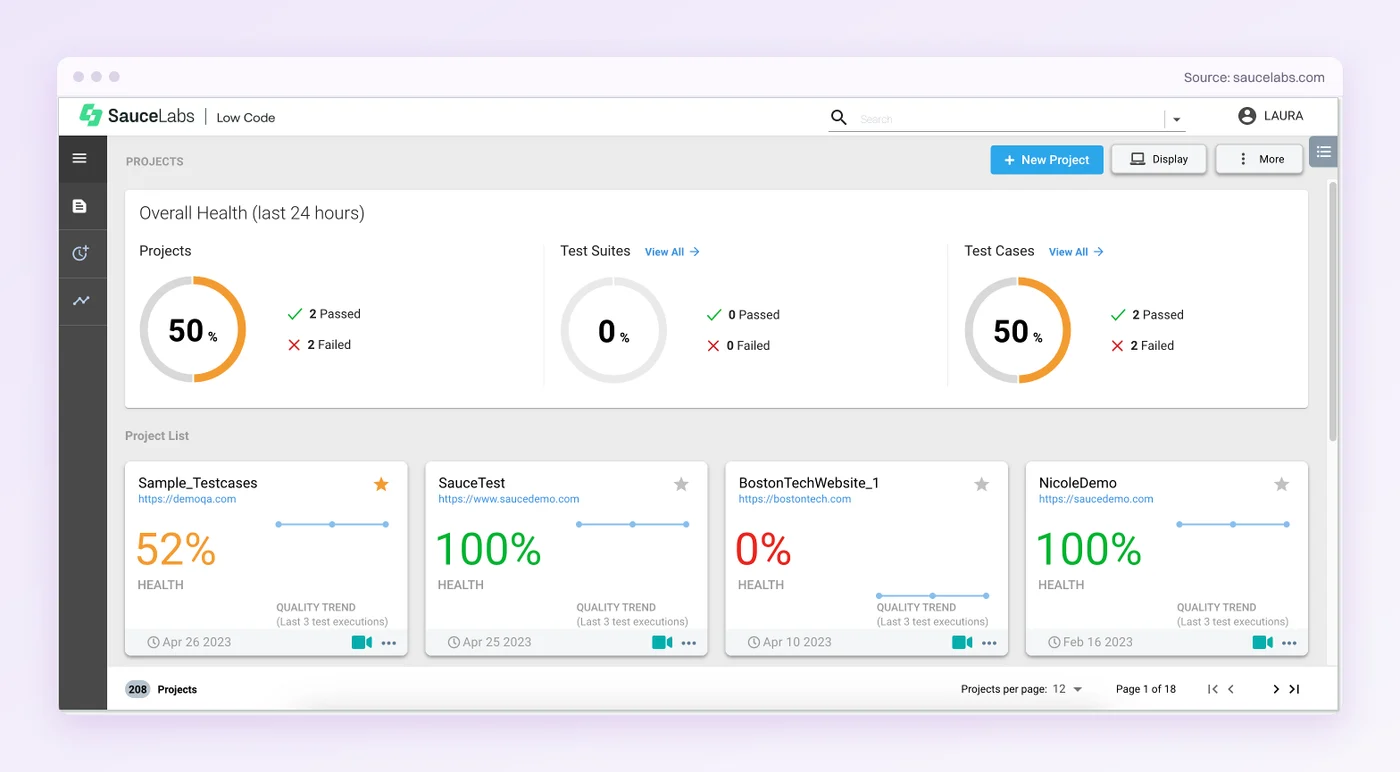
Sauce Labs earns its place as the automation-first grid. It was co-founded by Jason Huggins, who created Selenium, and the product reads that way. It pairs a Real Device Cloud with a Virtual Device Cloud of emulators and simulators, then layers analytics and enterprise controls on top. This year it launched AURA, its AI platform, and Enterprise plans now include two AI agents, one for writing tests and one for reading results.
Rating: 4.4/5 from 32 reviews on Capterra, as of September 2026.
Key features:
- Device cloud: Real devices plus emulators and simulators, with 1 to 24 parallel sessions on the standard plans.
- Sauce AI for Test Authoring: Turns plain language, product specs, or Figma designs into editable test cases you can convert to framework code.
- Sauce AI for Insights: Flags unstable tests and diagnoses failures across runs.
Pros:
- Selenium lineage: A natural home for large Selenium and Appium suites.
- Enterprise bundle: The Enterprise tier bundles SSO, a private device cloud, unified analytics, and both AI agents.
Cons:
- Speed under load: Reviewers flag slow execution on real devices and during parallel runs.
- Cost at scale: Cost climbs as you add concurrent sessions, and reviewers note limits on how many can run at once.
Pricing: Live Testing at $39/month, Virtual Device Cloud at $149/month, and Real Device Cloud at $199/month, billed annually with one parallel test each, per the Sauce Labs pricing page. The AI agents require an Enterprise plan.
Best for: Teams with a heavy Selenium or Appium investment that are buying at enterprise scale and want analytics in the same contract.
Not for: Small teams that want to try an AI agent before they sign an enterprise agreement.
Which Is Cheaper, LambdaTest or Sauce Labs?
TestMu AI is cheaper at the bottom of the range, and the gap closes as you move up. Its Virtual Live plan starts at $15 a month against $39 for Sauce Labs’ Live Testing, yet both list real-device automation at the same $199. Past the listed tiers, both move you to a custom quote, and that’s where parallel sessions decide the real bill.
| What you’re buying | TestMu AI (billed annually) | Sauce Labs (billed annually) |
|---|---|---|
| Cheapest live testing | $15/month, Virtual Live | $39/month, Live Testing |
| Desktop web automation | $79/month ($29 Linux only) | No separate tier listed |
| Virtual device automation | $139/month, Virtual Automation Cloud | $149/month, Virtual Device Cloud |
| Real-device automation | $199/month | $199/month |
| AI test agent | KaneAI from $17/month, self-serve | Included with Enterprise plans only |
Prices are from each vendor’s pricing page on September 28, 2026. The last row matters more than the rest. A small team can switch on KaneAI with a credit card and learn in a week whether agent-written tests hold up on its app. Sauce Labs asks you to have that sales conversation first.
TestMu AI wins on price and on access to its agent. Sauce Labs only draws level at the real-device tier.
Which Covers More Browsers and Devices?
TestMu AI publishes the bigger number, 10,000+ real devices and 3,000+ browser combinations, all reachable without a sales call. That matters when your users sit on a fragmented Android base and you’d rather not file a purchase request to test one more phone. Sauce Labs sells its fleet as two plans, a Real Device Cloud and a Virtual Device Cloud, and the choice between those modes is the practical one:
- Emulators and simulators: Fast to start and cheaper, which covers most regression runs where a virtual device behaves like the real one.
- Real devices: Catch what virtualization misses, like sensor behavior, manufacturer skins, and memory pressure on older phones.
Both vendors offer both modes, so decide which one you’ll lean on by default. A consumer app with a long tail of Android hardware points to TestMu AI’s fleet. A native team that already runs Appium and wants virtual devices cheap and fast in CI points to Sauce Labs. If BrowserStack is also on your list, we’ve put it against each of these two in Sauce Labs vs BrowserStack and LambdaTest vs BrowserStack.
TestMu AI wins on published breadth. Sauce Labs holds its own if virtual devices carry most of your runs.
Which Has Better Analytics and Enterprise Controls?
Analytics is Sauce Labs’ clearest win. Sauce AI for Insights reads across your run history to flag the tests that fail most and diagnose why, which is the view a QA lead needs to decide where engineering time goes. The Enterprise tier bundles it with SSO, a private device cloud, and unified analytics, so a regulated organization gets one contract instead of three.
TestMu AI ships Insights dashboards for test data and trends, and its enterprise plans add SSO and dedicated support. The reporting leans toward execution, meaning run times, pass rates, and where HyperExecute spent the minutes. For a fast team that lives in those numbers, it’s enough. For a platform group standardizing QA across many teams with audit requirements, Sauce Labs’ depth shows.
Sauce Labs wins on analytics depth. Buy it for this if you’re signing an enterprise plan anyway.
KaneAI vs Sauce AI: How the Two Test Agents Differ
Look, both agents are real, and both take hours out of writing tests. They differ in how you get them, what you feed them, and what they do when your UI moves.
| KaneAI (TestMu AI) | Sauce AI for Test Authoring | |
|---|---|---|
| How you get it | Self-serve, from $17/month | Included with Enterprise plans only |
| What you give it | Plain English, recordings, Jira tickets, PRDs, a pull request comment | Plain language, product specs, Figma designs |
| What you get back | Exportable Selenium, Playwright, Cypress, or Appium code | Editable test cases, convertible to framework code |
| When the UI changes | Updates the affected steps and shows you the diff to review | Re-resolves each step’s intent against the new UI, per Sauce |
The maintenance row is closer than the marketing on either side suggests. KaneAI keeps a locator-based step and patches it, with a human approving the change. Sauce’s AURA platform describes resolving a step’s intent against the current screen instead of failing on a stale selector, which is a real step past patching. Sauce AI for Test Authoring reached general availability for enterprise customers in spring 2026, so treat that claim as new and ask for a pilot on your own app.
What the two share is the starting point. Each one waits for your team to hand it something, a prompt, a ticket, a design, a recording, and then writes that one test. A faster drill still needs someone deciding where every hole goes.
That job is growing. In Sonar’s January 2026 survey of more than 1,100 developers, respondents said 42% of the code they commit is AI-generated or assisted. More code shipped means more flows someone has to describe before any agent can test them. If you’re weighing agents beyond these two, our ranking of AI test automation tools covers the wider field.
KaneAI is the one to try this week. Sauce AI makes sense once you’re on an enterprise plan and want its insights in the same place.
Where Pie Fits: Nobody Writes the First Test
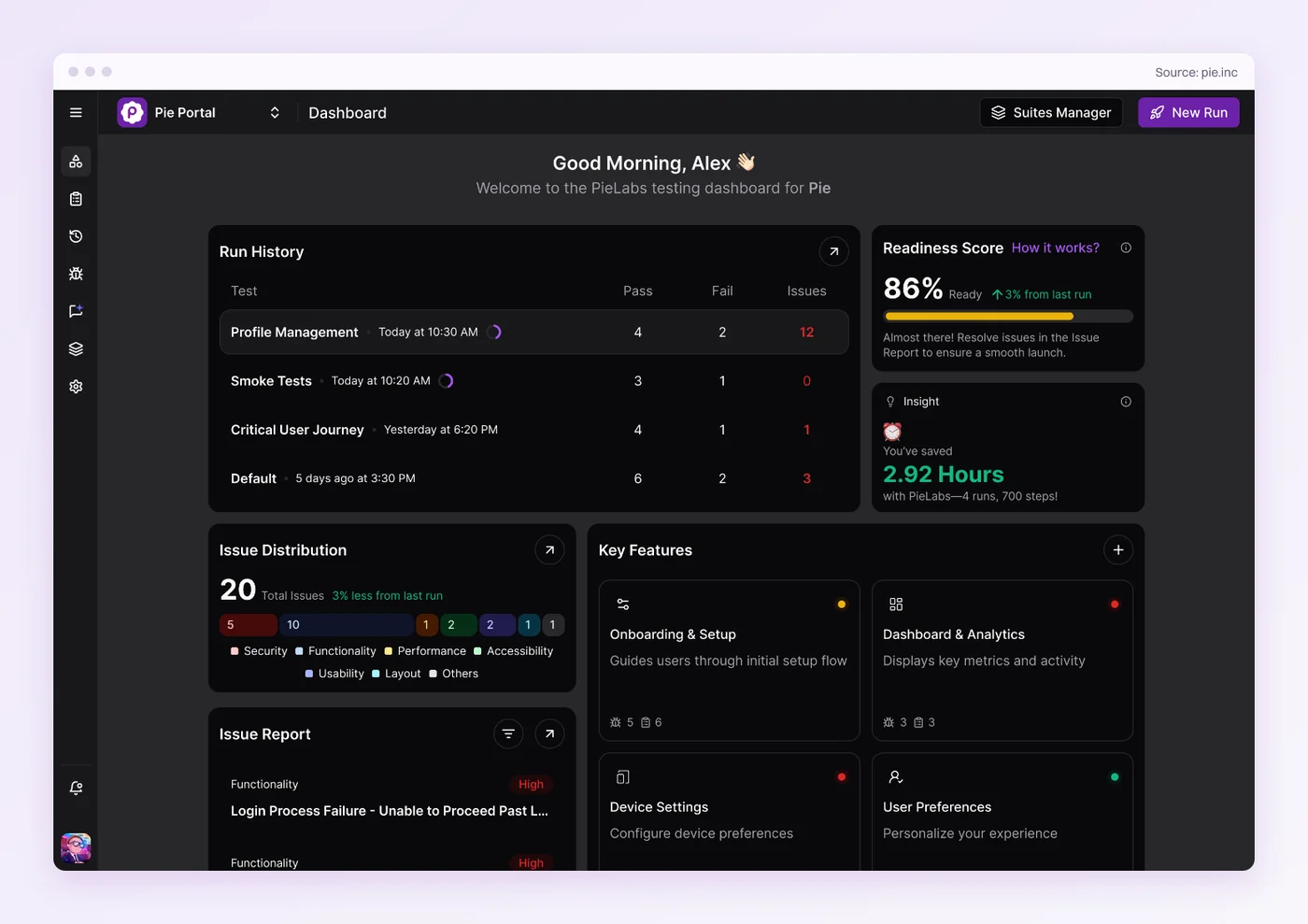
Pie isn’t a third grid, and it doesn’t try to be. It starts at the step both agents wait on, before anyone has described a test. Point Pie at your web app or a mobile build and its agents explore it, map every feature, and generate a suite your team reviews. Nobody on your team writes or maintains a selector.
We learned where the selector model runs out the hard way. In early 2025, several React Native apps we were testing hid part of their view hierarchy from us. Below a certain depth the tree the operating system reports simply stopped, so buttons a user could plainly see did not exist as far as any locator was concerned.
You can’t repair a selector for an element that isn’t in the tree. So we moved our mobile execution onto the screen itself. Our agents take a screenshot at each step and decide where to tap the way a person would.
Rating: 5.0/5 from 3 reviews on Gartner Peer Insights, as of September 2026.
Pricing: Custom, quoted to your team and your testing volume on request.
Best for: Teams whose bottleneck is writing and maintaining the suite, across web and native iOS and Android.
Not for: Testing on physical phones or across a long list of browser versions. Native apps run on simulators and emulators, so hardware-specific bugs stay grid work.
| TestMu AI | Sauce Labs | Pie | |
|---|---|---|---|
| Where the first test comes from | You describe it to KaneAI | You describe it to Sauce AI | Pie’s agents explore the app and propose it |
| How elements are found | Locators, patched by KaneAI | Step intent, re-resolved by AURA | What’s on screen, vision-first |
| Where tests run | 10,000+ real devices, 3,000+ browser combinations | Real devices, emulators, and simulators | Web, plus native iOS and Android on simulators and emulators |
| How you buy | Self-serve tiers, custom enterprise plans | Standard tiers, AI agents on Enterprise | Custom pricing, quoted to your team |
That Not for line is the cost of the choice, and either vendor above covers it well. Where Pie earns its place is the suite itself. As an autonomous QA platform, Pie gives you coverage before anyone has written a prompt, and tests that follow the screen when a redesign lands. See it on your own app and judge the suite it produces.
Start With a Suite, Not a Prompt
Point Pie at your app. Review the suite it maps for you.
Book a DemoLambdaTest, Sauce Labs, or Pie: Match the Tool to the Bottleneck
Grid shopping usually comes down to one of three problems. Name yours, then pick:
- TestMu AI: Pick it when cost and breadth lead, you’d rather skip procurement, and you want to trial an AI agent on a self-serve plan.
- Sauce Labs: Pick it when your suite is Selenium- or Appium-heavy, you’re buying at enterprise scale, and cross-run analytics and governance are requirements.
- Pie: Add it when the bottleneck is the suite, meaning the flows nobody has tested yet and the hours spent keeping the rest alive. Keep a grid for the physical-device and browser-version matrix, the job grids were built for.
The first two answer where your tests run. The third answers who writes them, and a team can need both. If you’re still widening the grid shortlist, our guide to BrowserStack alternatives covers the rest of the market.
Choose the Grid on Price and Analytics, Not the AI Label
TestMu AI is the better buy when price, breadth, and a self-serve path to an AI agent matter most. Sauce Labs is the better buy when you’re already enterprise-sized, run Selenium or Appium at volume, and want analytics you don’t have to build.
The AI both vendors now lead with is useful. It shortens the gap between a described test and a running one. It doesn’t describe the tests for you, and on an app whose view hierarchy gives out, a repaired selector has nothing to hold.
Pick the grid in an afternoon. Then look hard at who writes your tests, because that’s where the weeks go. We built Pie so the first draft of your suite doesn’t have to come from your team.
Fewer Prompts. More Shipping.
Keep the grid you like. Hand the first draft of the suite to Pie.
Book a DemoFrequently Asked Questions
Neither wins everywhere. TestMu AI, formerly LambdaTest, is the better value for self-serve teams that want broad coverage and an AI agent they can buy on a card.
Sauce Labs suits enterprises running Selenium or Appium at volume that want deeper analytics and governance.
TestMu AI is cheaper at entry, with Virtual Live at $15 a month billed annually against $39 for Sauce Labs Live Testing.
Both list real-device automation at $199 a month, and both move you to a custom quote once you need more parallel sessions.
Partly. KaneAI updates affected steps when locators change and shows you the diff to review. Sauce says its platform re-resolves each step's intent against the new UI.
Both start from a test someone on your team described, so deciding what to test stays a human job.
A self-hosted Selenium Grid, often run on Docker or Kubernetes, executes Selenium and Appium suites on machines you own.
You drop the subscription and take on the upkeep yourself, from browser versions and device provisioning to scaling the grid under load.
Not as a grid. Pie runs web apps and native iOS and Android apps on simulators and emulators, so a physical-device fleet or a wide browser matrix stays grid work.
Pie takes over the authoring. Its agents map your app, generate the suite, and find elements by what is on screen.
13 years building mobile infrastructure at Square, Facebook, and Instacart. Now building the QA platform he wished existed the whole time. LinkedIn →