mabl vs testRigor: You're Picking an Authoring Style, Not an Escape From Maintenance
mabl and testRigor both reach native mobile, both self-heal, and both still hand you a suite to own. Compared on authoring, reach, pricing, and upkeep.

Both of these tools work. mabl hands you a visual editor and an AI that drafts a test from a description. testRigor hands you a text box and asks you to type what the test should do. Pick either one and you will have a running suite inside a week, and both demos will be straight with you about that.
Neither demo covers the day after, when somebody inherits those tests and keeps them true for as long as the app keeps changing. That second job is what this comparison prices, because the differences the comparison pages argue about have closed. Native mobile and self-healing are table stakes on both sides now, and what is left is who does the work.
What you’ll learn
- Which differences between mabl and testRigor have closed since 2024
- What plain-English authoring really looks like inside testRigor
- What each one costs, and which tier carries the coverage you want
- Why neither authoring model changes who owns the suite
Quick Answer: mabl or testRigor
The difference between mabl and testRigor comes down to how a test gets written. mabl is a low-code platform built around a visual editor, with AI that drafts a test from a description, auto-healing that repairs element selectors when the interface moves, and the reporting depth a large QA org standardizes on. testRigor is a plain-English engine where every step is a sentence, and it reaches one platform further than mabl by covering native Windows desktop apps alongside web, API, and mobile.
Pick mabl if a QA engineer owns authoring and you want the platform around the tests as much as the tests. Pick testRigor if you want non-engineers writing them and a published price before you talk to sales. Pick neither if the problem is that nobody has the hours to build the suite in the first place.
| Dimension | mabl | testRigor |
|---|---|---|
| How you author | Visual editor, plus AI drafting from a description | Plain-English statements, typed |
| Who usually writes | QA engineers and SDETs | Manual QAs, PMs, business analysts |
| Platform reach | Web, API, native iOS and Android | Web, API, native iOS and Android, native Windows desktop |
| Surviving UI change | Auto-heals stored selectors | Selectorless references, plus AI auto-healing |
| Export to portable code | Playwright and Selenium IDE, partial | None |
| Entry price | Quote only | $300 per month for Linux and Chrome |
| Who owns the suite | Your team | Your team |
Reviewers lean testRigor’s way on both review sites, as of September 2026. On Capterra, mabl holds 4.0 out of 5 across 67 reviews and testRigor 4.6 across 5, and five reviews is thin ground to stand on. G2 has more reviews on both sides and a narrower gap, mabl 4.4 across 40 against testRigor 4.7 across 20, so read that pair as the fairer one.
What Is mabl?
mabl runs as a cloud service your team drives through a low-code editor. You build a test in the mabl Trainer, a browser extension that watches your interactions and turns them into editable steps, or you describe what you want and let mabl draft it. Runs happen in the cloud or inside your pipeline, and auto-healing updates element selectors when the DOM shifts.
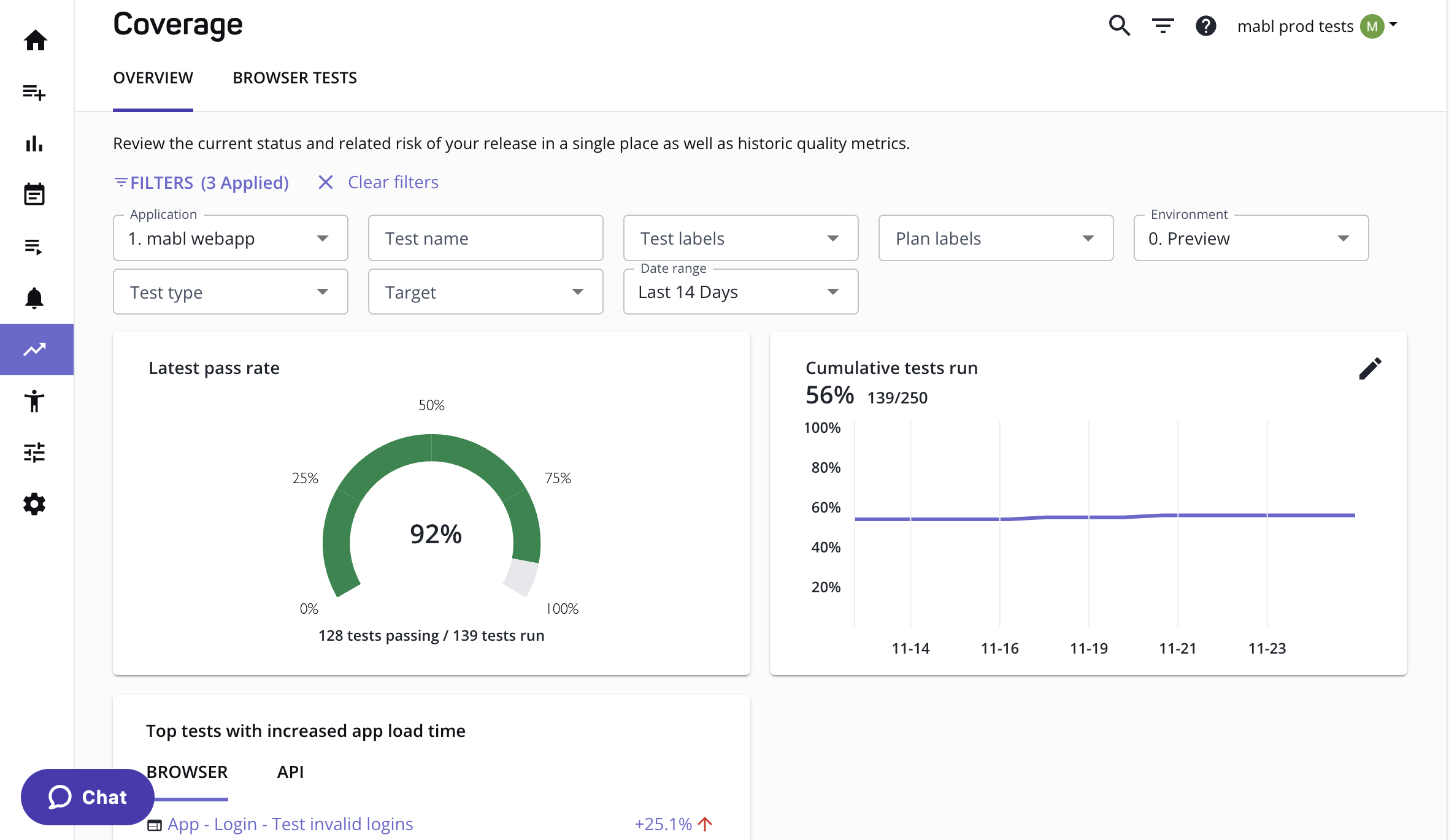
Maintenance is the pitch. mabl’s AI test automation page sells adaptive auto-healing as the way to cut it, and the coverage analytics in the screenshot above exist to prove that to whoever signed the contract.
On 23 April 2026 mabl relaunched the platform around agentic testing, promising “coverage that builds itself, runs itself, and recovers itself.” The same announcement describes how the building happens, and it starts from a generation session a person triggers from a browser, the command line, or an IDE. Faster authoring with recovery attached, in other words, and the suite it produces is yours to own from the first run.
Two Things Comparison Pages Get Wrong About mabl
mabl tests native iOS and Android apps as well as mobile web, and has since mobile app testing went generally available on 3 April 2024, per mabl’s help center release notes. Its tests are not trapped either, because the mabl CLI exports to Playwright and Selenium IDE, with the documented caveat that mabl’s own generated test types, such as the link crawler and visual smoke tests, do not export at all.
Reviewers give mabl 4.0 out of 5 across 67 reviews on Capterra, as of September 2026, and the complaints land on the editor, where rearranging the steps of a recorded test is awkward and the Trainer runs heavy on a workstation. Clunky editing is the standing tax across recorder-based testing tools, and mabl did not invent it.
Of the two, mabl is the enterprise platform, and you are buying the reporting and the pipeline as much as the recorder.
What Is testRigor?
testRigor takes the other route entirely. There is no recorder. You write each step as a sentence and testRigor interprets it, finding elements the way a person would rather than through a CSS or XPath selector. Its documentation defines a locator as “a way to describe finding elements from an end-user’s perspective,” and its homepage promises “free-flowing plain English to build test automation.”
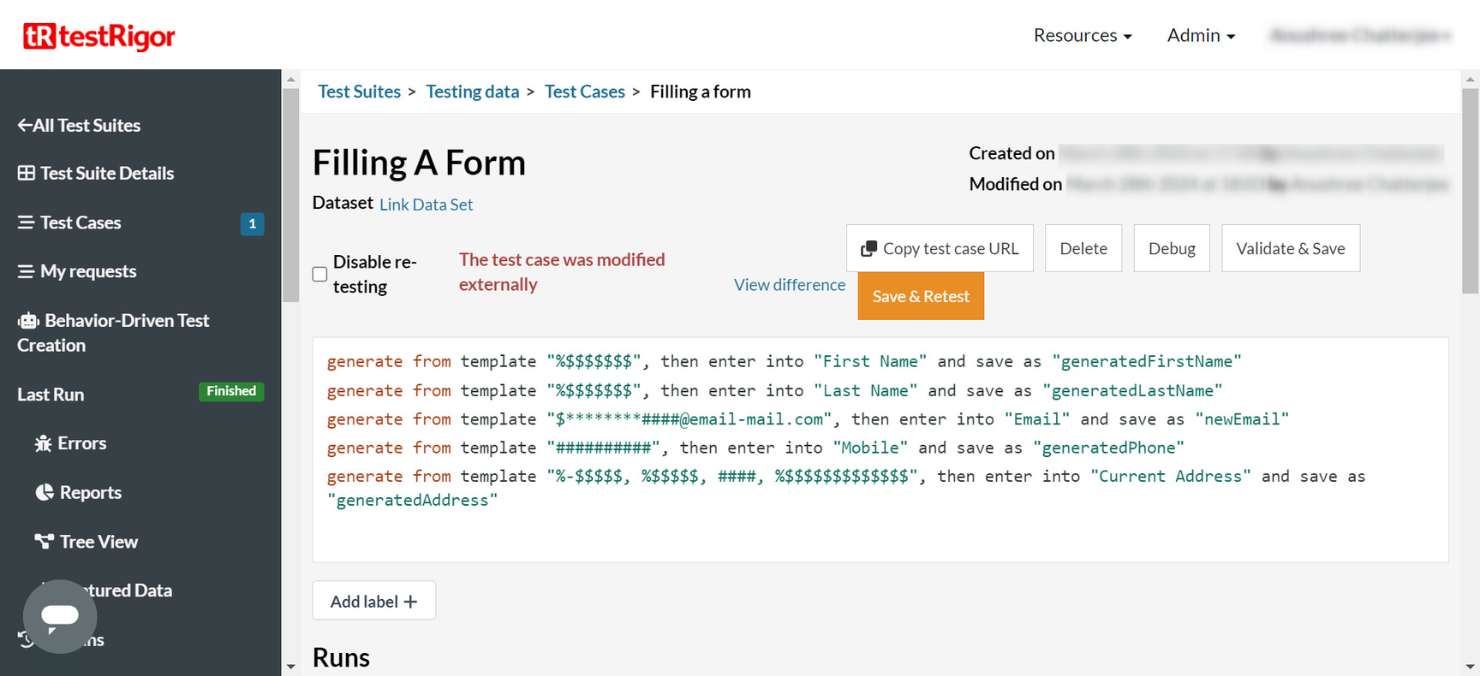
The screen above is worth a look before you buy the phrase. A production testRigor step reads like this:
generate from template "%$$$$$$$", then enter into "First Name" and save as "generatedFirstName"
generate from template "$*******####@email-mail.com", then enter into "Email" and save as "newEmail"
This is English the way SQL is English. It has reserved words, a template syntax for generated data, and a variable-binding convention to learn. The simple case really is simple, and testRigor’s docs show click on "cart" and check that page contains "Welcome, Peter!" doing what they read like. Once a test needs generated data, a saved variable, or a conditional, you are writing a domain-specific language with an English accent. None of that is a criticism, only what plain English costs, and it never shows up on a pricing page.
Reach Is the Real Edge
One syntax covers web, API, native iOS and Android, and native Windows desktop applications, and it handles the end-to-end scenarios that usually defeat automation, including SMS two-factor codes and automated phone calls, which testRigor documents on its own certification pages. testRigor also ships AI auto-healing, described on its self-healing page, and that matters, because describing an element in words does not by itself make a test permanent.
testRigor holds 4.6 out of 5 across 5 reviews on Capterra, as of September 2026. Two things come up in those reviews. There is no built-in test management, so one reviewer tracks cases in a spreadsheet alongside the tool, and another found implementation took more meetings with support than they wanted.
testRigor reaches furthest and asks least of your engineers, and the plain English is still a language somebody on your team has to learn.
Where mabl and testRigor No Longer Differ
Three of the differences that used to decide this purchase have closed. Native mobile is covered on both sides. Someone who cannot code can produce a working test on either, mabl by drafting from a description and testRigor by parsing a sentence. Each repairs itself when the UI moves. A comparison written before 2025 is arguing about a product that no longer exists, and what remains is narrower and considerably more useful to you.
| Aspect | mabl | testRigor |
|---|---|---|
| Primary authoring surface | Trainer browser extension and visual editor | A text box |
| Reporting and analytics | Coverage dashboards, pass-rate trends, load-time regressions | Reports and errors per run |
| Desktop apps | Not covered | Native Windows |
| Getting your work out | CLI export to Playwright or Selenium IDE | No export path |
| Test management | Plans and labels inside the platform | Bring your own |
| Price visibility | Quote only | Entry tier published |
Healing is the one place they look alike and behave differently. mabl repairs a locator after the interface changes, so it is reacting to a break inside the selector model it chose. testRigor never stored a selector, so a whole class of breakage never reaches it, then it heals the remainder with AI anyway. A QA lead who ran a proof of concept on two tools in this class found the advertised self-healing only kicked in after every stored locator had failed, which is repair, not immunity.
One Capterra reviewer calls mabl’s auto-healing sleek, and fair enough. Sleek healing is still healing. Each is a real improvement on hand-maintained selectors, and neither is what self-healing test automation gets sold as, which is a suite that stops needing you. The line that matters runs between AI that writes tests and AI that tests, and these two tools sit on the writing side of it.
mabl wins on reporting depth and on not locking up your work. testRigor wins on reach and on who is allowed to write a test.
Why Only One of Them Shows You a Price
testRigor publishes numbers and mabl does not, and the gap is smaller than it first looks. testRigor’s sign-up page lists four tiers, and the tier is where the detail hides.
- Public: Free, on the condition that your tests and results are public, which rules it out for most commercial products.
- Private: From $300 per month, covering Linux and Chrome only.
- Private Complete: The tier that carries mobile, Windows desktop, and multi-OS coverage, and the one with no published figure.
- Enterprise: Pricing on request.
mabl is quote-based throughout. Its pricing page runs a request-a-quote flow and states a starting point of 500 credits per month for cloud test runs, with local runs free. Credits are the unit that scales, so the number to model is run volume, plus the cost of maintaining the tests that no credit covers.
What Two Buyers Paid For
The surprise arrives with run volume. An engineering leader who ran mabl at a previous company, and taught two manual testers there to build the suite themselves, told us it took his team six months to break the run budget he had told them to break. After that he had to make end-to-end runs opt-in per deploy and be judicious about how often they ran.
The testRigor side has its own version. An engineering leader running six apps at a Series A company said he had evaluated the category and stayed on testRigor. Not because it was great, he said, but because for what it provides it was good enough and the price was reasonable for a startup that cannot splurge. A published price got the pilot approved. It did not make the tool one he loved.
testRigor is ahead on transparency, and on the price of the configuration you would buy, both of them send you to sales.
Who Writes Your Tests Decides This
The choice comes down to who sits in the editor and what you ship on. Everything else in this comparison is a consequence of those two answers, so start there and read the row that describes your team.
| Your situation | mabl | testRigor | Pie |
|---|---|---|---|
| A QA engineer builds tests in a visual editor and wants deep CI reporting | ✓ | ✗ | ✗ |
| You want a published starting price before you talk to sales | ✗ | ✓ | ✗ |
| Product managers and manual QAs write the tests themselves | ✓ | ✓ | ✓ |
| One test definition covers web and the native iOS and Android apps | ✗ | ✗ | ✓ |
| Nobody on your team owns the suite between releases, so it goes stale | ✗ | ✗ | ✓ |
| You need coverage before anyone has described a single test | ✗ | ✗ | ✓ |
The first two rows are the argument everyone else is having, and mabl and testRigor take one each. Row three is shared, because all three let a non-engineer write a test. The last three are where a suite comes from and who keeps it alive, and both authoring columns sit blank there, because a faster editor cannot generate an undescribed suite, and cannot own it once you have. mabl runs web and mobile tests side by side in one plan, which is not one test covering both.
Choose mabl If
Your QA engineers own authoring and you want the platform around the tests as much as the tests. The reporting, coverage analytics, and pipeline integration are why large orgs standardize on it, and the Playwright export means you are not signing away the work if you leave later. Budget for a sales conversation, and put the Trainer on a real engineer’s machine before you commit, because reviewers say it is heavy.
Choose testRigor If
Product managers, analysts, or manual QAs will author the tests, and you need one syntax across web, mobile, and Windows desktop. Nothing else in this class reaches as far, and a published entry price makes a pilot easy to get approved, which is exactly how the Series A buyer above bought it. Plan for a ramp while the team learns the language, and plan to bring your own test management.
The dependency runs the other way too. A tester put it to testRigor’s co-founder on the Ministry of Testing forum in December 2021.
If you get a problem or if you realize one day that you need a feature, you have to rely on the company’s capacity to fix/develop the feature.
The reply listed what testRigor already covered, which answers a different question. That concern is why the export row exists in the table above, and it is where mabl, with its export, has half an answer.
Consider Autonomous QA If
Look, the editor question may not be your constraint at all. When the hours to write the suite do not exist, the tests you already have are the ones that get abandoned, and we hear that story on call after call. Pie is an autonomous QA platform that generates the suite instead of helping you write it, which makes it a different purchase from anything on the best test automation tools list.
mabl or testRigor is a real decision when somebody on your team is going to write the tests. When nobody is, it is not a decision at all.
Why Faster Authoring Never Shrinks the Suite
mabl’s maintenance claim and testRigor’s selectorless model aim at the same cost, and both aim at the back half of it. They make repairing an existing test cheaper. Neither changes how many tests exist, who decided each one was worth writing, or who notices when one quietly stops covering anything.
Suites rarely die from broken selectors. They die from being owned by people who have something else to do. What teams tell us on calls is consistent and undramatic. Tests go stale, then they get skipped, then somebody comments them out to get a release through, and nobody ever uncomments them.
When a team tells me their regression suite runs to the thousands, my first question is what share of it is active, because a lot of those tests end up commented out for flakiness. On a discovery call in July 2025, the QA lead who had just described a suite that size said keeping up with incoming features was the first challenge.
mabl’s Own Survey Says the Same
mabl’s 2026 State of Quality Engineering Report, a survey of 996 software quality professionals, developers, and technology decision-makers across the US and UK that mabl released alongside its April 2026 relaunch, is the vendor’s own research and reads like our argument. 37% of respondents said AI produced code faster but at lower quality, respondents reported spending about 20% of the working week manually verifying AI-generated tests and code, and 35% said most production bugs are found by customers.
Volume Is Moving the Wrong Way
Two measurements from the last year point the same direction.
- More defects per pull request: CodeRabbit’s State of AI vs Human Code Generation report, published December 2025, analyzed 470 open-source GitHub pull requests labelled AI or human by authorship signals, and found AI-co-authored pull requests carried 10.83 issues each against 6.45 for human-only ones. More pull requests arriving, each carrying more defects, landing against a suite the same people maintain by hand.
- More teams hitting flaky tests: Bitrise’s Mobile Insights 2025 report, published 12 November 2025 on more than 10 million of its builds from January 2022 to June 2025, found the share of teams seeing any flaky tests grew from 10% to 26%, which Bitrise’s Arpad Kun described in SD Times as the likelihood of encountering a flaky test rising from 10% in 2022 to 26% in 2025.
Faster authoring does nothing about any of it. It leaves you with more tests to own.
AI has made it easier to write a test, and a test that is easier to write still catches only the flow it was written for. What you get is more flows to keep alive, and you can keep fixing those forever without it adding value. Autonomous QA goes after the front half instead. Pie’s agents explore the app, decide what is worth covering, and generate the suite, which changes what a test case even is once no person wrote it.
Both tools cut the cost of fixing a test, and neither cuts the number of tests you are responsible for.
Buy the Authoring. Budget for the Ownership.
mabl and testRigor are both good at the thing they are sold on, and they sit closer together than either vendor lets on. Either one earns its keep on the flows you want to drive by hand, and then the suite is yours, and it stays yours.
We built Pie for the version of this problem where that job has no takers. Its agents explore the app, generate the tests, and find elements by what is rendered on screen, so your team never writes or maintains a selector, and real people on our QA team check what the agents surface before it reaches you. Skip the authoring, and the ownership goes with it.
Frequently Asked Questions
13 years building mobile infrastructure at Square, Facebook, and Instacart. Now building the QA platform he wished existed the whole time. LinkedIn →