Best Testim Alternatives in 2026: Heal the Locator or Remove It
Testim's smart locators repair tests instead of retiring them. Compare seven alternatives on ratings, real pricing, and what reviewers actually complain about.

Testim’s smart locators repair themselves, and reviewers still describe hand-tuned fixes. That gap sends people looking for an alternative. Blame the model underneath, not Testim.
Most alternatives lists sort on feature count, which is how a team buys a new invoice and keeps the old ceiling. Sort on one question instead. Does the tool still keep a locator pointed at an element, or has it stopped keeping one? In 2026 that line no longer runs between us and everybody else.
What you’ll learn
- The four reasons teams leave Testim, taken from real reviewer complaints
- Seven alternatives with current ratings, real pricing, and named trade-offs
- Where the selector line actually falls in 2026, and who has crossed it
- A four-question routing test that eliminates most of the list for you
Why Teams Look Past Testim
Testim is a capable platform, and the people who built smart locators were solving a real problem. It carries 4.6 out of 5 from 50 reviews on Capterra, which is not the profile of a bad product. The friction shows up in the second year, and reviewers on Capterra, G2 and TrustRadius keep naming the same four things.
- Maintenance shrinks but doesn’t end. Reviewers describe locator stability problems across development branches, trouble with complex UI like multiple browser tabs, and upkeep that is not completely hands-off, because an unusual component can still demand a hand-tuned fix. Healing a locator is a real improvement over hand-editing XPath. It still leaves an element reference in the test that something has to keep correct.
- Cost reads high to smaller teams. The recurring phrasing across G2 and TrustRadius is that pricing runs “relatively high, particularly for smaller teams or organizations working with limited budgets.” That complaint tracks team size, not satisfaction, which is why it sits alongside strong ratings instead of contradicting them.
- Big suites get slow. Capterra and TrustRadius reviewers report crashes, “slowness in code merges when running Testim tests in parallel,” and high memory and CPU consumption. This is the complaint that arrives with scale, which means it arrives after you’ve committed.
- Mobile is layered on, not native. Testim was built web-first and gained mobile later through technology Tricentis brought in after acquiring the company in February 2022. If your release risk lives in a native iOS or Android app, you are buying the thinner half of the platform.
Rank those against each other before you shop. A cost problem and a maintenance problem point at opposite ends of this list, and picking for the wrong one is how teams land somewhere with an identical ceiling and a different invoice.
Testim Alternatives Side by Side
The second column is the whole decision. Tools that keep a locator will heal it for you, and go on healing it for as long as you pay them. Tools that don’t keep one have nothing to heal.
| Tool | Who keeps the locator correct | Pricing and license | Best for |
|---|---|---|---|
| Pie | Nobody, there is none to keep | Custom pricing, proprietary | Ending maintenance across web and native mobile |
| Autify | Nobody in Aximo, Autify in NoCode | From $99/mo, proprietary | Buyers who want a published price |
| mabl | mabl, by auto-healing | Custom pricing on a credit model, proprietary | The closest managed replacement |
| testRigor | testRigor, from your written step | Custom pricing, proprietary | Testers who don’t code |
| Katalon | Katalon, on paid tiers | From $84/seat/mo, proprietary | Breadth across web, API, mobile, desktop |
| Playwright | You, by hand in code | Free, Apache 2.0 | Strong dev teams testing web |
| Cypress | You, by hand in code | Free under MIT, paid cloud | Front-end JavaScript teams |
We applied five criteria the same way to every tool on the list.
- Authoring model: who or what produces the test in the first place.
- Locator dependency: whether a persistent element reference survives between runs.
- Reach: web only, or native iOS and Android too.
- Published pricing: a real figure on the vendor’s own page, or a quote.
- Reviewer sentiment: recurring complaints from G2, Capterra and TrustRadius, not our own reasoning dressed up as reviews.
Ratings were checked in September 2026 and move week to week, so read them as directional. We build Pie, so treat our entry with the skepticism you’d apply to any vendor writing its own row, and check the claims we make that a screenshot could disprove.
Seven Best Testim Alternatives
The seven below are ordered by how far each one moves you off the locator. The first two have stopped keeping one, the middle three heal one for you, and the last two hand you the code and the responsibility.
1. Pie: No Authoring Step at All
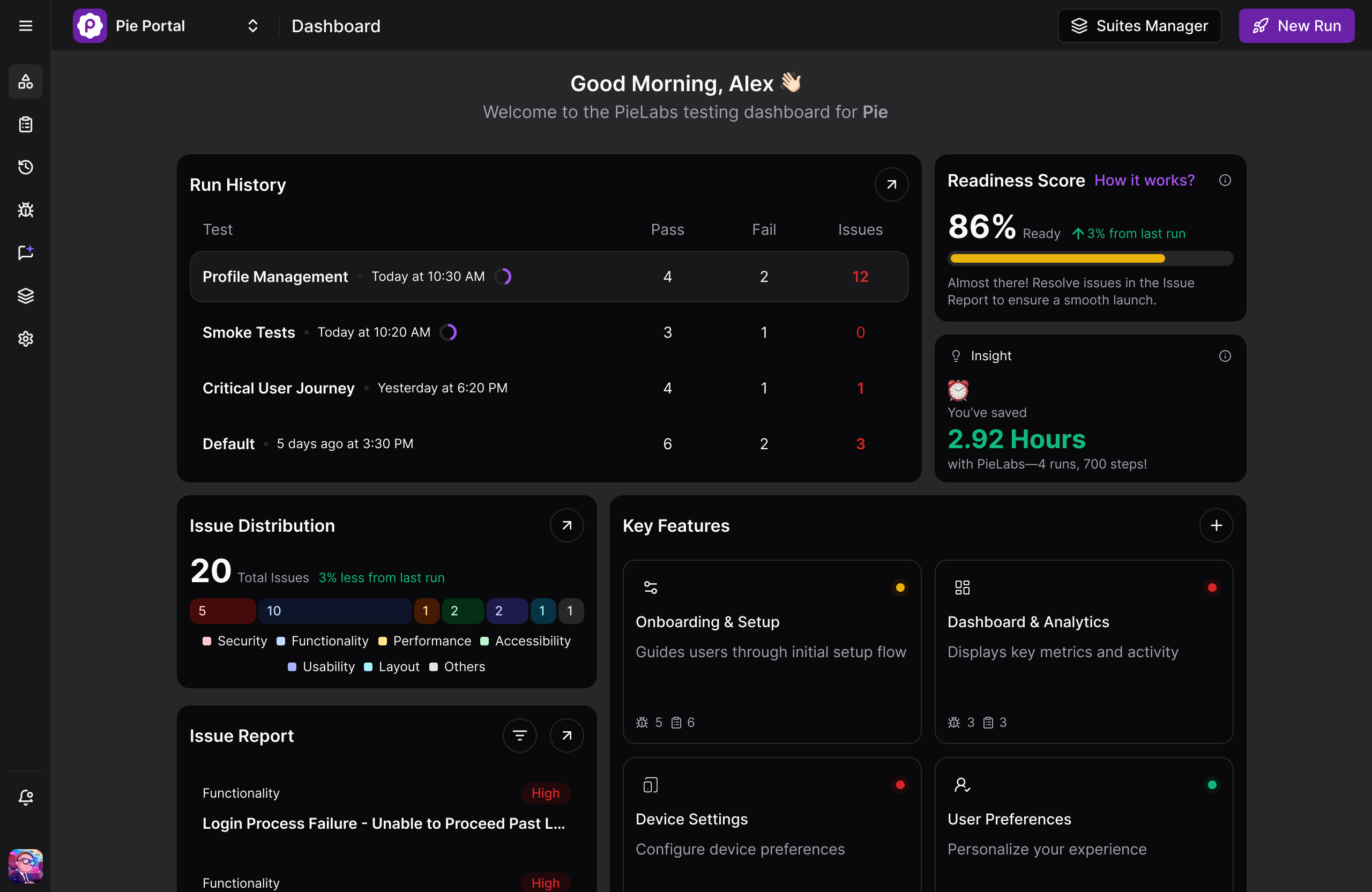
Pie earns the top spot for the reason most people leave Testim, which is that the maintenance never fully went away. There is no recording session and no authoring step. Hundreds of AI agents explore the app, map the flows, build a knowledge graph and generate the suite, which is why autonomous discovery covers 60% to 80% of core flows on day one without anyone writing a test. Execution then runs through the rendered screen rather than an element ID. When a specific flow needs pinning down, Pie Canvas takes it as a plain-English test case.
The second thing that matters is reach. One behavior-based definition runs across web, native iOS and native Android, which is the exact seam where a web-first tool starts asking you to maintain a second suite. Teams already running self-healing test automation elsewhere usually arrive here because healing stopped scaling, not because it never worked.
Now the part we’re not going to dress up. On native mobile the execution is fully vision-based and there is no locator anywhere in the loop. On web it’s a hybrid, and the driver still uses some DOM locators internally where they’re more reliable. Nobody on your team writes one or fixes one, which is the promise that matters, but “there are no selectors” would be an overclaim on web and we’d rather you hear it here than find it later.
”The time between having a release candidate ready and being fully tested has gone from two to three days to a few hours.”
— Philip Hubert, Director of Mobile Engineering, FiRating (September 2026): 5.0 out of 5 on Gartner Peer Insights.
Pricing: Custom pricing, available on request.
What we’d flag: Web execution runs on Chromium, not every browser engine, and it’s a vision-first hybrid rather than pure vision. Mobile runs on simulators and emulators, never physical hardware.
Best for: Teams whose bottleneck is maintenance, not capability, especially with a native mobile app in the release.
Not for: Unit or performance testing. Pie is end to end, and it isn’t a drop-in for a unit framework.
See It On Your Own App
Point Pie at your build. Watch it map flows you never wrote tests for.
Book a Demo2. Autify: Published Tiers and a Selector-Free Agent
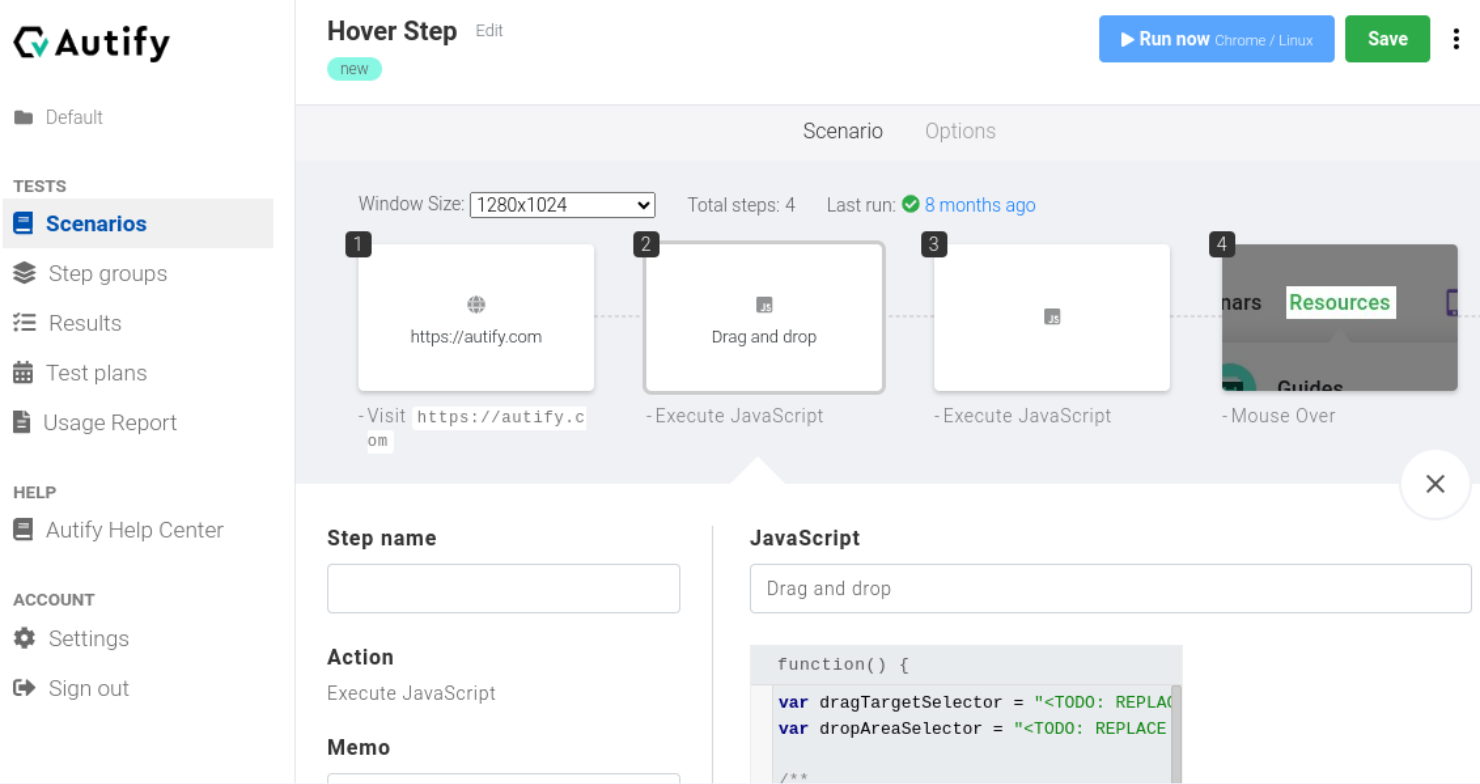
Autify belongs high on this list for a reason we have to state against our own interest. Its Aximo agent makes the same architectural claim we do. Autify’s own product page says Aximo “doesn’t rely on scripts or selectors” and “executes directly against your application, so changes don’t introduce maintenance work,” across web, mobile and desktop. If a rival’s homepage can disprove a differentiator, the differentiator was never the point, so treat “removes the locator” as a category of two rather than a moat.
The complication for a buyer is that Autify runs several product lines with different architectures. The older NoCode recorder heals a stored element fingerprint, which puts it in the healing group, and Nexus is a separate Playwright-based line with its own tiers. Aximo is the newer agent and the one that matches the claim above. Know which one you’re being quoted for.
Rating (September 2026): 4.8 out of 5 from 12 reviews on G2.
Pricing: Aximo publishes tiers, which almost nobody in this category does. Free with 2,000 one-time credits, Core at $99 per month billed annually, Team at $450 per month billed annually. Nexus and NoCode carry their own price lists.
What reviewers flag: A thin self-serve learning path, with one reviewer asking for self-tutorial videos, plus a narrow integration set and difficulty automating dynamic data like pricing and discounts.
Best for: Teams that want a selector-free agent and a published price before a sales call.
Not for: Teams that want one product to standardize on, since NoCode, Nexus and Aximo are separate architectures with separate price lists.
3. mabl: The Closest Managed Replacement
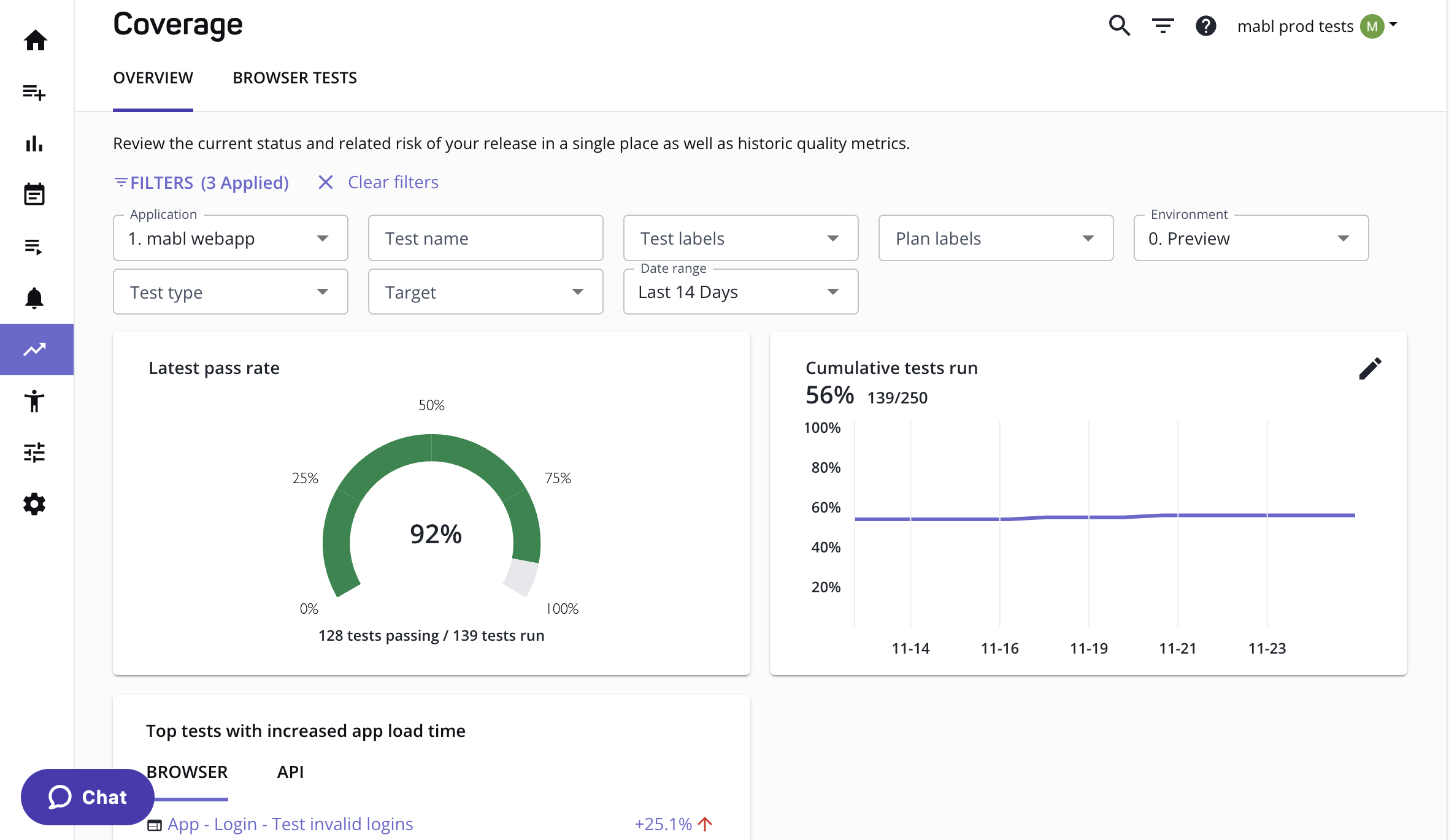
mabl is the alternative that feels most like Testim, which is exactly why it earns a spot. It’s a managed low-code SaaS built around recorded tests, with auto-healing when an element moves. It tracks a wide set of attributes per element and its agentic tester updates the locators when the UI shifts, and it has added authoring that plans a test from a described user story or a pasted Jira ticket. The subscription bundles UI, API, accessibility and performance testing rather than metering them separately.
The ceiling is the honest caveat. mabl blends visual context into locator scoring, but it still keeps and heals a locator, so if the reason you’re leaving Testim is that healing didn’t end the work, this is a lateral move with better packaging. That ceiling is the subject of mabl and testRigor compared.
Rating (September 2026): 4.4 out of 5 from 40 reviews on G2.
Pricing: Custom pricing on a credit model, with 500 credits a month for cloud runs on the published entry configuration.
What reviewers flag: “Slow cloud run, random failure in execution” against local Playwright or Selenium, cost relative to value, and gaps in desktop and browser coverage.
Best for: Teams that liked Testim’s approach and want better packaging or a different commercial relationship.
Not for: Teams leaving specifically to get off locator maintenance.
4. testRigor: Tests Your Manual QA Can Own
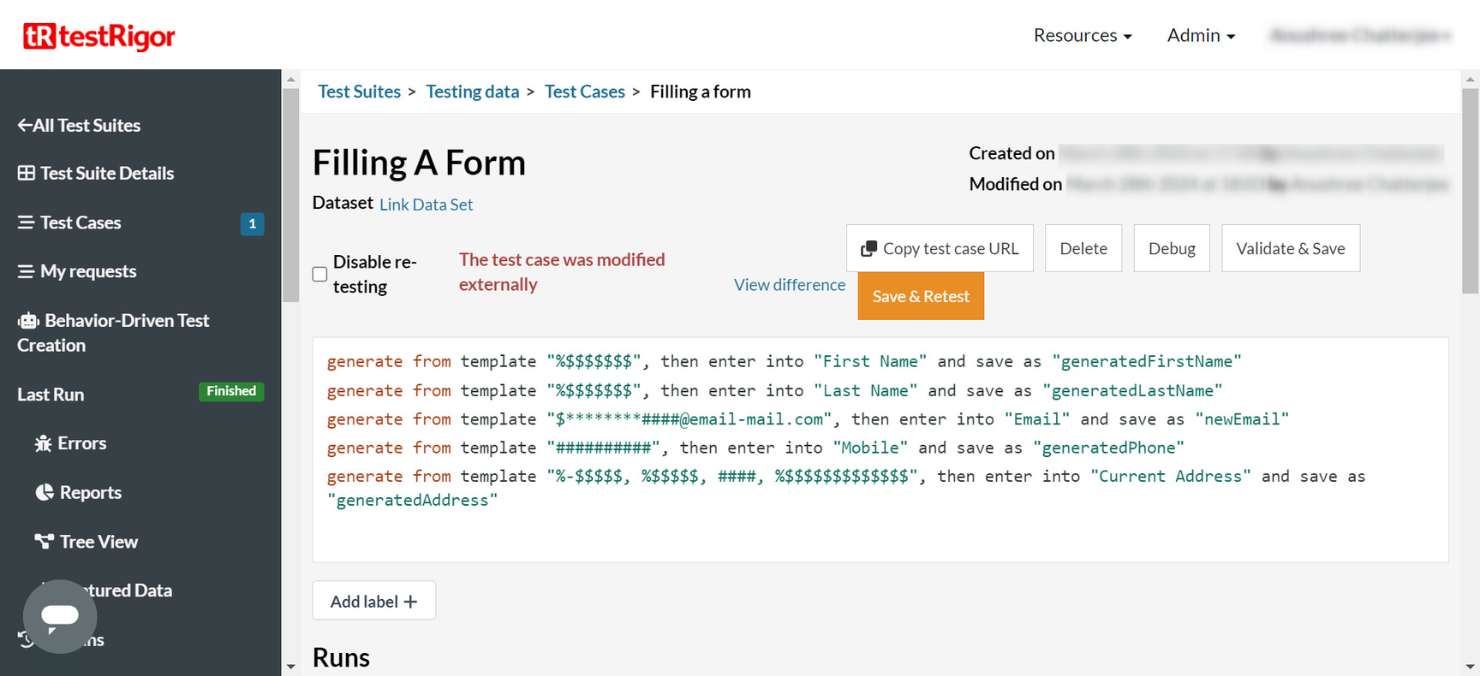
testRigor earns its place by changing who is allowed to write a test. Steps are free-flowing plain English, so “click on ‘Add to Cart’” is the test rather than a CSS path, and the reference is the thing a user can see rather than an implementation detail. For a team whose real constraint is that only two engineers can touch the suite, that’s the unlock, and it survives UI churn better than XPath because a button’s visible label changes less often than its DOM position.
There is still a ceiling. It just sits somewhere else. Complex conditional logic has to fit inside the platform’s interpretation layer, and reviewers describe a learning curve around how testRigor reads less common commands. You trade a locator problem for an interpretation problem, which is a better trade for most manual QA teams and a worse one for a suite full of branching.
Rating (September 2026): 4.7 out of 5 from 20 reviews on G2, and 4.6 out of 5 from 5 reviews on Capterra.
Pricing: Not published. Charged on parallel infrastructure rather than per test or per user.
What reviewers flag: No built-in test management, with one Capterra reviewer keeping track in spreadsheets, a UI that “can feel slow at times,” and a learning curve on how the platform interprets less common commands.
Best for: QA teams without a coding background who found Testim’s editor still too technical.
Not for: Suites with heavy conditional branching, or teams that need test management inside the same tool.
5. Katalon: Breadth Across Four Surfaces
Katalon makes the list because it covers more surfaces than anything else here. Web, API, mobile and desktop in one low-code studio, built on Selenium and Appium underneath, with a free desktop IDE substantial enough to evaluate properly before anyone signs. For a QA org that would otherwise stitch four frameworks together, consolidation is a real reason to switch.
The inheritance cuts both ways. Sitting on Selenium and Appium means inheriting their locator fragility, and Katalon’s own documentation frames self-healing as a configurable priority list of locator strategies, XPath by default, then attributes, CSS and image, while warning that the image locator “might have issues finding the element.” Vision is one entry in a locator list here, not the model.
Rating (September 2026): 4.4 out of 5 from 218 reviews on G2, one of the largest review pools in the category.
Pricing: Katalon Studio runs $84 per seat per month billed annually for the first three seats, roughly $1,008 a year, then $150 per seat. A free desktop IDE covers evaluation.
What reviewers flag: The G2 dislike tags are unusually blunt. Slow performance appears in more than twenty reviews, with expense, system delays and the learning curve behind it in that order.
Best for: QA orgs that need four surfaces covered on a predictable per-seat budget.
Not for: Teams switching to escape locator maintenance, since self-healing sits on paid tiers and still heals a locator.
6. Playwright: Own the Code Instead of Renting the Abstraction
Playwright earns a spot because for a strong engineering team it is genuinely the better trade. Microsoft built it, auto-waiting removes the single most common source of timing flakiness, and one API drives Chromium, Firefox and WebKit with bindings for TypeScript and JavaScript, Python, .NET and Java. The playwright package pulled 87.5 million downloads in the last week of August 2026, which tells you the ecosystem and the answers are there.
The trade runs opposite to Testim’s. No license fee, total control, and every test is code an engineer writes while every DOM-changing redesign is a locator somebody fixes by hand. That math favors Playwright when your team is strong and your UI is stable, and it turns against you the moment either of those stops being true.
Rating (September 2026): 4.8 out of 5 from 12 reviews on G2.
Pricing: Free, Apache 2.0.
What reviewers flag: Thin community support outside the documentation, failure diagnosis that “isn’t always super straightforward,” and memory and CPU growth during long parallel sessions.
Best for: Engineering teams that would rather own the maintenance than pay for someone else’s abstraction.
Not for: Teams without engineers to spend on the suite, or anyone testing a native mobile app.
7. Cypress: The Front-End Team’s Daily Driver
Cypress makes the list on developer experience, which sounds soft until you count how many suites die because nobody enjoys touching them. It runs inside the browser alongside your app, so it gets direct DOM and network access, time-travel snapshots and an interactive runner, and it covers component testing next to end to end.
The boundaries are published and worth reading before you commit. Cypress documents that “the only language we’ll ever support is the language of the web: JavaScript” and that there is no native or mobile events support. Like Playwright, it’s code-first, so the maintenance is yours.
Rating (September 2026): 4.7 out of 5 from 107 reviews on G2.
Pricing: Free under MIT. Cypress Cloud adds parallelization and analytics from $67 a month on the Team plan, or $799 a year.
What reviewers flag: Capterra reviewers cite limited multi-browser support, “‘Detached from DOM’ is a common issue,” and no native parallelization without the cloud service.
Best for: JavaScript and TypeScript front-end teams bringing testing back in-house.
Not for: Anything native mobile, or a polyglot org that needs bindings beyond JavaScript.
Which Alternative Fits Your Reason for Leaving
Name the reason first. Shopping on feature lists is how a team switches to a tool with Testim’s exact ceiling and a different logo. Four questions eliminate most of this list.
- Is it cost or is it maintenance? If the invoice is the problem, Playwright or Cypress removes it entirely. If broken tests are the problem, a free framework makes it worse, because you now own every fix and the cost of test maintenance moves from a line item to a headcount question.
- Heal the locator, or stop keeping one? mabl, Katalon and Autify’s NoCode line heal, same paradigm as Testim. Pie and Autify’s Aximo agent execute without one. Only the second group changes the ceiling.
- Who writes the tests? Non-engineers are served by plain English with testRigor or a no-code recorder with Autify. Strong dev teams usually want the control of Playwright or Cypress. If the answer is that nobody should have to, Pie has no authoring step to staff.
- What has to be covered? Web only, or native iOS and Android as well. Most of this list is web-first, and that single requirement rules out roughly half of it, so weight it heavily if native mobile is where your release risk lives.
Worth saying that these aren’t mutually exclusive. Plenty of teams keep Playwright or Cypress for precise developer-owned checks and run autonomous QA across the broad, frequently-changing surface that breaks everything else.
Shop the Model, Not the Feature List
There’s no single best Testim alternative, and any list that crowns one without asking why you’re leaving is selling something. Cost sends you to Playwright or Cypress, who writes the tests sends you to testRigor or Autify, and breadth across four surfaces sends you to Katalon. If what you want is the closest managed replacement for what you already have, it’s mabl.
If you’re leaving because the tests still break, none of those change the arithmetic. Healing a locator faster is still keeping a locator, and something has to keep it correct forever. The only switch that shrinks the maintenance backlog instead of relocating it is the one that stops keeping one, and that group has exactly two members today.
We built Pie because we got tired of paying engineers to be selector mechanics. Name your reason, shortlist the two tools that match it, and run them against your real app for a sprint. The teams who don’t regret this a year later picked for their constraint, not for the demo.
Stop Maintaining Locators
Bring your worst-maintained suite. We'll show you what stays green.
Book a DemoFrequently Asked Questions
There is no single best one. There is a best one for why you are leaving. If maintenance is the reason, look at tools that execute without a locator, which today means Pie and Autify's Aximo agent. If cost is the reason, Playwright and Cypress are free and code first. If your testers do not code, testRigor writes steps in plain English. If you want the closest managed replacement for what Testim already does, mabl.
Reviewers on G2, Capterra and TrustRadius keep raising the same four things. Smart locators reduce maintenance without ending it, and reviewers describe locator instability across branches and hand tuned fixes. Cost reads high to smaller teams. Larger suites hit slowness and memory pressure in parallel runs.
The fourth is reach. Testim started as a web tool and added mobile later through Tricentis technology, so teams whose real bottleneck is native iOS and Android tend to look elsewhere.
Yes. Playwright is free under Apache 2.0 and Cypress is free under MIT, and both are mature enough to run a serious suite. Katalon publishes a free desktop IDE for evaluation. The trade is real though. You swap a license fee for engineering hours, because every test is code somebody writes and every UI change is a fix somebody owns. Free tools make maintenance cheaper to buy and more expensive to run.
Tricentis does not publish a Testim price list, and contracts run annually rather than month to month. Public figures circulating on third party estimate sites are not confirmed by Tricentis, so treat them as guesses rather than quotes. Get a number directly from Tricentis before you budget. Worth knowing that quoted pricing is normal in this category rather than a Testim quirk, and several tools on this list price the same way.
It does, with a caveat worth understanding. Testim was built for the web first, and mobile arrived later through technology Tricentis acquired, so the mobile story extends a web platform rather than starting from native. Teams testing a native iOS or Android app as their primary surface usually find the web capabilities deeper than the mobile ones, and that gap is one of the more common reasons the search for an alternative starts.
They are worth it when they remove work rather than move it. That is not automatic. In a 2025 randomized trial, METR found experienced open source developers took 19 percent longer to finish tasks when allowed to use AI tools, while believing the tools had made them 20 percent faster.
Apply the same skepticism here. Ask a vendor what specifically stops being your job, then ask what replaces it.
Testim records a flow, generates locators for the elements in it, and repairs those locators when the UI shifts. The test still points at elements, so a big enough refactor still lands on somebody's desk.
Pie has no authoring step at all. Agents explore the app, map the flows and generate the suite, then execute through the rendered screen. On native mobile that is fully vision based. On web it is a hybrid that still uses some DOM locators internally, but nobody on your team writes or maintains one.
For native iOS and Android, yes, and that is the swap teams make most often. Pie runs one behavior based definition across web, native iOS and native Android instead of a separate mobile suite bolted onto a web tool. Mobile execution is fully vision based, so a class rename or a layout refactor does not turn the suite red.
Two honest limits. Pie is end to end, not a unit or performance testing tool, and it will not find every issue in your app.
13 years building mobile infrastructure at Square, Facebook, and Instacart. Now building the QA platform he wished existed the whole time. LinkedIn →