Is AI Test Automation Reliable? Yes, When the AI Doesn't Get the Final Vote
Every AI testing model gets things wrong. Reliability depends on who owns the pass or fail call. Here's how to spot a tool that will ship you a false pass.

The AI in your testing tool will be wrong some of the time. Every model is, ours included. A wrong answer that turns a build red gets investigated. One that turns it green ships the bug, because nothing looked broken enough for anyone to check.
Reliability comes down to who owns that pass or fail call. An AI that finds the Sign In button and taps it is doing narrow, checkable work. An AI that decides your checkout “looks fine” and marks the build green is making a call it should never make alone. Keep the final vote away from the model and AI test automation is reliable enough to gate a release.
What you’ll learn
- Why a model’s accuracy matters less than who owns the pass or fail call
- The two products sold as “AI test automation” and how each one fails
- Why the false pass is the failure to engineer against
- Five questions to ask before you trust an AI testing tool with a release
AI Test Automation Is Two Different Products
“AI test automation” describes two products that share a label and almost nothing else. Before you can judge reliability, you have to know which one is in front of you, because they fail in different ways and earn trust by different rules.
AI-Assisted Scripting
You still author the tests, and AI suggests selectors, drafts steps from plain English and heals locators when a class name changes. The suite is yours, and the AI is a copilot on top of a framework like Selenium or Playwright. Its reliability question is narrow, because a human writes the assertions.
Autonomous AI Testing
Here the AI does the work end to end. It explores your app, maps the flows, generates the suite, and runs it by what’s on the screen, so nobody writes or maintains a selector. Nobody authored the assertion either, which is exactly why its reliability model has to be different.
I drew the same line when I compared AI that writes tests with AI that tests. One speeds up authoring. The other takes over running the flow.
Much of the advice on whether AI testing is reliable was written for the first product. Guides that do cover the second mostly warn about unpredictability, an agent taking a different path on a different run. Fair, and incomplete. Here’s how the two compare against the scripted baseline they’re both meant to replace.
| Approach | What the AI does | Who owns pass/fail | Main reliability risk | Survives a UI change? |
|---|---|---|---|---|
| Traditional scripted automation | Nothing | Your hand-written assertions | Flaky selectors and timing | No, selectors break |
| AI-assisted scripting | Finds and heals elements, drafts steps | Your assertions, kept deterministic | Over-trust in a green run | Often, locators adapt |
| Autonomous vision-based QA | Discovers flows, generates and runs the suite | Fixed expected outcomes, plus your team’s review | False pass if a run is unverified | Yes, tests by what is on screen |
The scripted baseline isn’t the safe default it gets treated as, either. A selector suite goes red when someone renames a class and stays green on any flow nobody wrote an assertion for, so “is AI reliable?” was never being asked against a reliable baseline.
Reliable Means the AI Doesn’t Own the Verdict
The single rule that makes AI testing trustworthy is a separation of duties. The AI handles interpretation. A fixed check or a person handles judgment. The two jobs look alike from a distance and fail in opposite ways.
| Job | The question it answers | Who should own it | What happens when the AI owns it |
|---|---|---|---|
| Interpretation | Which element is the Sign In button? Did the page finish loading? | The AI | Resilience, because a moved button or renamed class no longer breaks the test |
| Judgment | Did checkout do the right thing? Can this build ship? | A fixed check or a person | A release gate that changes its mind from one run to the next |
Pie didn’t invent this split, and the people buying AI testing are already wary of the alternative. In the World Quality Report 2025, 60% of respondents named hallucination and reliability concerns among their top challenges with AI in quality engineering. testRigor’s guide to trusting AI test automation lands in the same place: “As risk increases, AI autonomy should decrease.” When a probabilistic model gets to define what “success” means, your production gate becomes probabilistic too, and an unpredictable gate isn’t a gate.
Vision-based execution is what makes the interpretation half reliable. A test bound to a CSS selector or an XPath breaks when someone renames a class or moves a button. A test that identifies elements the way a person does, by what they look like on screen, absorbs that change instead of failing on it. That resilience is real and worth having.
The mistake is assuming resilience on the interpretation side also covers you on the judgment side. It doesn’t. A test can adapt perfectly to a moved button and still be dead wrong about whether the feature worked.
False Passes Are the Failure Nobody Demos
The reliability risk that matters for autonomous testing isn’t the false failure. A test that goes red when the app is fine is annoying, and you notice it immediately because someone has to go look. The dangerous one is the false pass: a test that reports green while the flow underneath it broke. It works like a fuel gauge stuck on full, where nobody checks the tank because the needle says they don’t need to.
A false pass is worse than a red build because it compounds. The first time a stakeholder finds a bug your AI suite marked as passing, they stop trusting every green check it ever produced.
The agent taps Pay, a spinner clears, and the screen looks like a confirmation, so the run goes green. The order never reached your backend.
Deterministic pipelines already have a version of this. In a 2025 paper, researchers who went through 81 industrial projects named it the silent failure, a CI job marked successful that failed to finish some or all of its work, and found developers rerunning 11% of successful jobs anyway. I’ve written about tests that pass on a broken app before. An AI given final judgment can produce them at a scale no human tester could.
So a reliable autonomous system has to be engineered against its own optimism. It needs the expected outcome fixed before the run, a bias toward flagging anything that looks off, and evidence a person can check after.
None of that shows up in a demo, because demos are built to pass. It shows up on release forty, when the app has drifted and the tool either quietly starts lying or quietly keeps catching things. Release forty is the reliability you’re buying.
5 Questions to Ask Before You Trust an AI Testing Tool
You can’t benchmark this by watching a scripted demo, and a ranked list of AI test automation tools won’t settle it either. You evaluate it by interrogating the architecture. Five questions separate a reliable AI testing tool from one that will hand you a false pass on a busy release day:
- Who owns the pass or fail verdict? If the answer is “the AI, on its own,” walk. Reliable tools keep a deterministic check or a human on the final call, especially on critical flows.
- What happens when a step looks wrong? There should be a defined answer, and “mark it passed and move on” is the wrong one. You want a tool that files the doubt, not one that rounds it up to green.
- Can you inspect the evidence? Every run should show its work. If you can’t see why something passed, you can’t trust that it did.
- Does it adapt to UI change, or break? Ask specifically about a renamed element and a redesigned page. Resilience to change is the difference between coverage that lasts and coverage that rots. Lasting coverage is what self-healing test automation is supposed to buy you, and plenty of tools claim it, so ask how.
- Will the vendor name its limits? Ask what the tool can’t test and where it needs a person. A vendor that answers “nothing” and “nowhere” has already shown you its first false pass.
Run those five at any vendor, including us.
How Pie Keeps the Verdict With Your Team
Pie is the autonomous kind of AI testing, so the rules above apply to us first. The agents explore your app through autonomous discovery, generate the regression suite, and run it by what the screen shows. Nobody writes or maintains a selector, so a redesign that renames every element doesn’t quietly gut your coverage. That covers the interpretation half.
The judgment half stays where your team can see it:
- Readable assertions: Every test case spells out its expected outcomes in plain English, so you know what a pass means before you trust one.
- Screenshots at every step: A green run shows what Pie saw, screen by screen.
- Your triage: Findings come to your team to track or reject, and Pie learns from what you reject.
- Reviewed fixes: When Pie catches a regression, Pie Loop can draft a fix and open a PR your engineers review and merge.
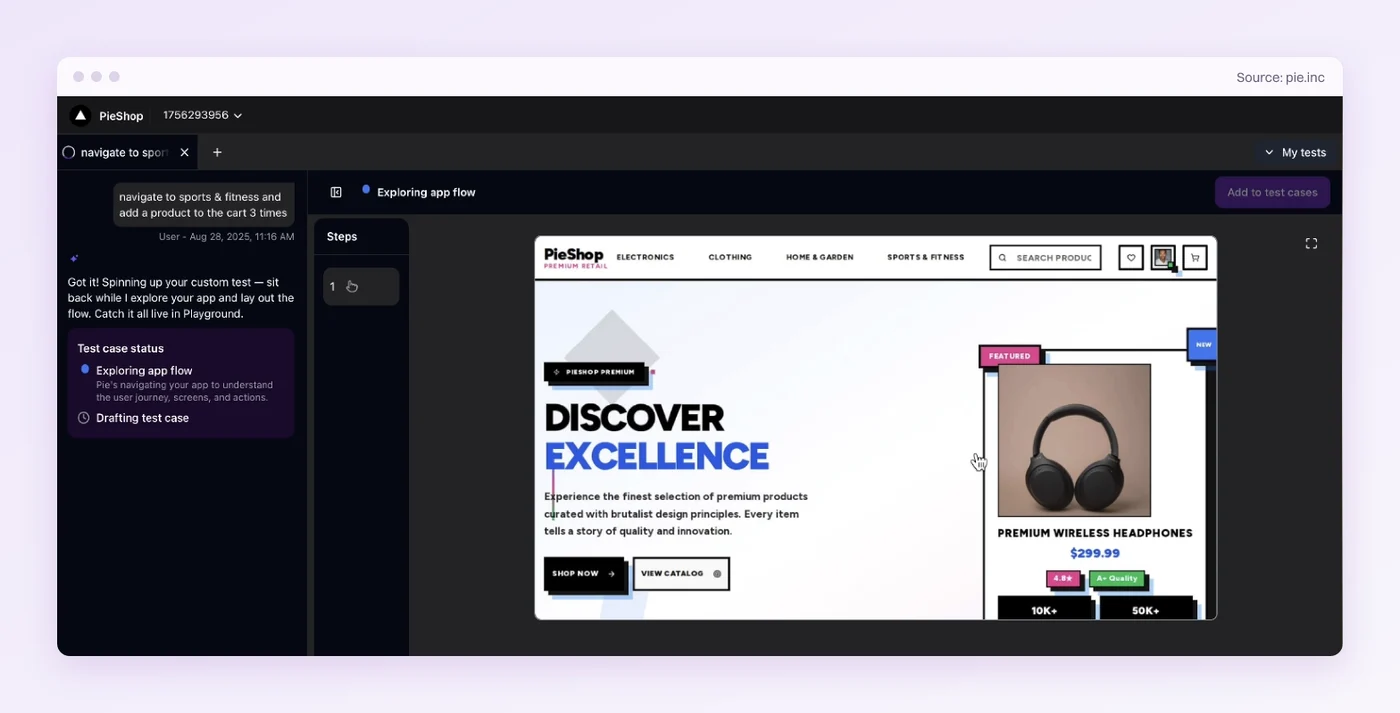
We tune Pie hard against the false pass. If a step goes wrong, even a tap that lands on the wrong button, the run files an issue instead of shrugging it off. The cost is that Pie flags plenty of things that turn out to be fine.
Our customers put up with a few false alarms as long as the real bug doesn’t slip through and they aren’t buried in noise. Findings go through filtering before they reach you, and flaky or test-data noise is dropped automatically.
Trust the Architecture, Not the Adjective
AI test automation is reliable enough to trust with a release today. The model will be wrong some of the time, so the reliability has to come from what surrounds it, and the false pass is the failure to design against.
The word “AI” on the box tells you how a product works, not whether you can trust it. Ask a vendor who owns the verdict and what happens when a step looks wrong, and the reliable tools separate from the confident ones fast.
We built Pie to do the labor and leave the merge button with your team. The model gets plenty of votes. It never gets the last one.
Frequently Asked Questions
Yes, for regression, smoke and critical-path suites, as long as the AI isn't the thing deciding pass or fail. Let the AI find elements, adapt to UI changes and run the flows.
Keep a fixed expected outcome or a person on the verdict, and the release gate stays predictable.
You can, with one rule. The more critical the flow, the more explicit the human gate on the result.
For a payment or compliance flow, a passing AI run is evidence a person reviews before anything ships, not an automatic green light.
It can do the work on its own. AI can explore an app, map its flows, generate a suite and run it without anyone writing a script.
A reliable setup keeps the final call on whether a run passed with a fixed check or a person.
It can. An AI deciding where to tap may take a slightly different path from one run to the next.
That's acceptable when the expected outcome is fixed and every step leaves a screenshot. A verdict that changes with the path is not.
No. AI takes over the parts of the job nobody wanted, like writing brittle selectors, rerunning the same regression pass by hand and repairing tests after a UI change.
The role moves from writing and running tests to reviewing what the AI finds and deciding what ships.
The one that keeps AI off the final pass or fail call, shows evidence for every run, survives UI changes and tells you what it can't test.
Testsigma, testRigor and mabl all offer AI-assisted authoring and self-healing. Judge each of them, and Pie, on those four points.
Pie's agents generate and run the suite without selectors anyone has to maintain, so a redesign doesn't break coverage. Each test case spells out its expected outcomes, and every step is captured as a screenshot.
Your team triages what Pie finds and reviews any fix before it merges.
13 years building mobile infrastructure at Square, Facebook, and Instacart. Now building the QA platform he wished existed the whole time. LinkedIn →