Codeless vs Code-Based Test Automation: Recorder or Scripts?
Codeless tools get non-coders testing fast and code frameworks give engineers control. Compare both, see which fits your team, and what neither one fixes.

Record a login flow in a codeless tool and you’ll have a passing test in minutes. Script the same flow in Playwright and you’ll need an engineer, a test harness, and a good deal longer. Every comparison of these two approaches starts from that gap, and the gap is real.
Look, it only describes the first week of a test’s life. Both approaches tie each test to a selector, so both break when a developer renames a class. Pick on who can write the tests, then budget for who fixes them, because that second bill arrives either way.
What you’ll learn
- What codeless and code-based automation each are, with a real locator example
- Five differences that decide which one fits your team
- When to choose each, and when to run both
- The maintenance cost neither approach removes, and where Pie fits
Quick Answer: Codeless or Code-Based?
Choose codeless if manual testers or product people will write the tests and your flows are standard, such as login, forms, checkout, and navigation. Choose code-based if engineers will own the suite and you need conditional logic, custom test data, or tests wired into your own infrastructure. Many teams run both. If nobody has the hours to maintain a suite at all, the authoring choice matters less than the upkeep.
Codeless vs Code-Based at a Glance
| Dimension | Codeless | Code-Based |
|---|---|---|
| Who writes tests | Manual QA, product, analysts | Engineers and SDETs |
| Time to first test | Minutes, with a recorder or plain-English steps | Longer, after framework and harness setup |
| Complex logic and data | Limited to what the editor supports, or an escape into code | Anything the language can express |
| Where tests live | Inside the vendor’s platform | In your repo, as code you own |
| How elements are found | Selectors captured by the recorder | Selectors written by hand |
| Who fixes a broken test | Your team, re-recording or healing | Your engineers, re-scripting |
The last two rows read almost the same, and they are the rows you pay for longest.
What Is Codeless Test Automation?
Codeless test automation builds tests without writing a programming language. You click through the app while a recorder captures each step, arrange steps in a visual editor, or write them as plain-English sentences, and the tool turns that into something it can execute. Katalon pairs a recorder with Groovy or Java scripting for the hard parts (our Testsigma and Katalon comparison shows both styles side by side), and testRigor takes free-flowing English and uses AI to keep those tests running as the app changes.
The draw is who gets to write tests. A manual tester or product manager who knows the acceptance criteria can encode them directly instead of filing a ticket and waiting for an engineer.
Under the hood, most codeless tests turn out to be code. A solo QA engineer covering web, mobile, and a browser extension described the AI codeless tool she was using to us in December 2025 in one line: “they convert your recording and prompt to Playwright code.” The recorder saves the typing. The script, and the selector inside it, are still there.
What Is Code-Based Test Automation?
Code-based test automation writes each test as a script in a framework such as Selenium, Playwright, or Cypress, in a language like JavaScript, TypeScript, Python, Java, or C#. An engineer writes the steps, the assertions, and the locators, and gets everything the language offers: loops, conditionals, fixtures, and direct calls to your APIs and database.
Here is one login step in Playwright, written two ways:
// Tied to the markup: breaks when a class or wrapper div changes
await page.locator('#login-form > div.actions > button.btn-primary').click();

// Tied to what the user sees: survives a class rename
await page.getByRole('button', { name: 'Sign in' }).click();
Playwright’s own locator guide recommends the second form and warns that CSS and XPath selectors “can break when the DOM structure changes.” Role-based locators help. They break anyway the day someone relabels the button “Log in.” Picking among frameworks is a separate decision, and Cypress and Selenium make opposite bets on language and browser reach.
Codeless vs Code-Based: 5 Key Differences
1. Who Can Write Tests
Codeless drops the skill floor, so QA analysts and product managers can build coverage without a scripting queue. Code-based needs engineers, which makes your coverage a function of the engineering hours you can spare for tests.
Codeless widens the pool of authors. Code-based keeps authoring with engineers.
2. Speed to the First Test
A recorder produces a runnable test as fast as you can click through the flow. A code-based suite needs a framework installed, a harness and config, and hand-written scripts before the first flow runs, though that setup is paid once.
Codeless gets you running sooner. The head start shrinks after setup.
3. Complex Logic and Test Data
Record-and-replay handles standard flows well, then runs into scenarios that need judgment.
- Conditional logic: Branching on app state the visual editor did not anticipate.
- Test data setup: Seeding a database, minting a token, or calling an API before the UI test starts.
- Deep integration: Anything that reaches past the browser into infrastructure you control.
Vendors know this, which is why tools like Katalon give you an escape into code. The harder the scenario, the more a codeless suite turns into a code-based one.
Code-based has no ceiling beyond the language. Codeless has the editor’s.
4. Portability and Lock-In
Code-based tests are files in your repository. You diff them, review them, and take them with you to the next framework. Codeless tests live in the vendor’s platform, and that trade shows up when you want to leave. A practitioner on the Ministry of Testing forum put it this way in December 2025:
“You also run into issues with no-code tools in that if they close up shop or you need to move tools, you can’t really export those (unless they expose the code underneath somehow).”
Ministry of Testing Club, December 2025
Code-based tests are yours to keep. Codeless tests stay where the vendor keeps them.
5. Maintenance When the UI Changes
Both approaches find elements through a selector: a CSS class, an XPath, an ID, or an accessibility label. The recorder captures it behind a friendly screen, and the framework has you type it. When a developer renames a class or wraps a button in a new div, the test fails even though the feature works, and someone has to triage a failure that was never a bug.
Codeless tools have narrowed this with AI self-healing, which swaps in a new locator when the old one stops matching. That repair happens inside the selector model. The test was bound to markup, and healing re-binds it.
Call it a tie. Both break when the selector does.
Which One Should You Choose?
Choose Codeless If
- Manual testers, PMs, or analysts will write most of the tests
- Your flows are standard web or mobile journeys with little branching
- You want coverage this month without hiring an SDET
- You can live with tests stored in a vendor’s platform
Choose Code-Based If
- Engineers will own the suite and review it like any other code
- You need conditional logic, custom data setup, or API calls inside tests
- You want tests in your repo, portable across tools
- You can budget engineering time to write the suite and keep it green
Run Both If
- Your broad regression surface is standard, but a few critical flows need code-level control
- Different people own different parts of the app
Whichever you pick, the framework decision comes next, and a wider list of test automation tools maps where each option fits.
What Neither Approach Fixes
Codeless changes who writes the test. Code-based changes how much control they have. Neither changes what the test is attached to, so three situations break both kinds of suite the same way.
- Look-alike elements: Several similar buttons or fields on one page, where a small DOM change points the locator at the wrong one.
- Redesigns: A visual refresh that keeps every feature but rewrites the markup, turning much of the suite red overnight.
- Fast iteration: A UI that changes every sprint, so the suite never settles long enough to maintain.
The third one is getting more common. In the JetBrains State of Developer Ecosystem 2025 survey of 24,534 developers, 85% said they regularly use AI tools for coding and development. More code per sprint means more UI changes per sprint, and every one of them lands on a selector somewhere.
Buyers already feel it. A QA lead who evaluated Pie in January 2026 had close to half a dozen testing tools in his pipeline, and self-healing was the first requirement on his list. Nobody asks that question first unless maintenance is where the hours go. For the arithmetic on your own suite, test maintenance cost walks through the inputs.
Where Pie Fits: No Selector to Break
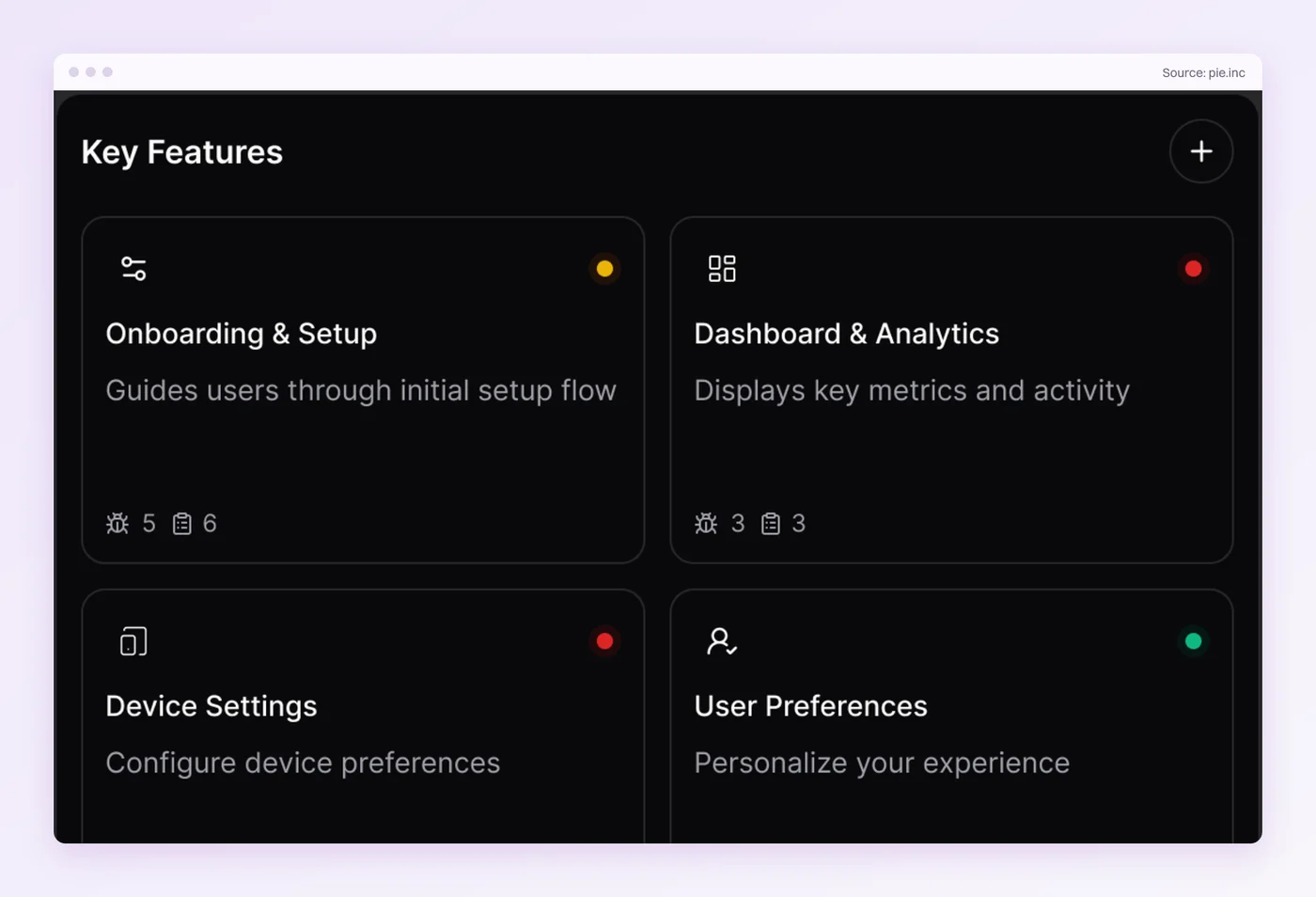
Pie is an autonomous QA platform that sits outside both columns. Nobody records a flow or writes a script. Agents explore your web or mobile app, map its features, and generate the end-to-end tests, then locate elements from what’s rendered on screen when each test runs.
- Discovery instead of authoring: Autonomous test discovery maps the app’s flows and builds the first suite before anyone writes a test.
- No selectors to maintain: The agents identify elements by what the user sees, so a renamed class or moved button doesn’t send anyone back into the test.
- Plain-English custom tests: When you need a specific flow covered, you describe it in a sentence.
- Runs beside your framework: Keep Playwright or Selenium for the logic-heavy flows and let Pie cover the broad regression surface nobody has time to script.
Here’s what Pie won’t do. It will never understand your product as well as your team does, so the business rules that matter most stay yours to name. Fi, the smart dog collar company, runs its release testing on Pie alongside its own development process.
Authoring Is a One-Time Cost. Upkeep Is Not.
Codeless gets more of your team writing tests. Code-based gives your engineers control over every step. Both are fair answers to the question of who writes the suite.
Neither answers who keeps it running. The recorder captures a selector, the framework asks you to type one, and the same redesign breaks both.
We built Pie so that second question has a different answer. Its agents work from what the user sees, so nobody on your team writes or maintains a selector, and a renamed class stops being a ticket on your board. If your team spends more hours fixing tests than writing them, start there.
Stop Re-Recording Tests
Bring the flow that breaks every sprint. See it run with no selector.
Book a DemoFrequently Asked Questions
Codeless automation builds tests with a recorder, a visual editor, or plain-English steps, so people who don't code can write them.
Code-based automation writes tests as scripts in a framework like Selenium, Playwright, or Cypress, which takes an engineer but gives full control.
The terms overlap. No-code means you never touch a script. Low-code lets you drop into code for the hard parts. Codeless usually covers both.
The useful question for a buyer is where a tool forces you back into code, because that's where its ceiling sits.
Codeless tools struggle with heavy conditional logic, custom data setup, and anything the visual editor didn't anticipate. Tests also live inside the vendor's platform, which makes switching tools hard.
And recorded tests depend on selectors that break when the UI changes.
Not for standard flows like logins, forms, and checkout. A manual tester can record or describe those without code.
Complex scenarios usually need an escape into code, so most teams keep at least one person who can script for the flows the editor can't express.
Neither has a structural edge. A recorder captures a selector for you and a framework has you write one, and both break when a class name or layout changes.
AI self-healing narrows the gap by repairing the broken locator after the fact.
Yes, for tests that need precise logic, custom data, or deep integration with your own systems. No visual editor matches a full programming language there.
What has changed is the pace of UI change, which makes a large hand-maintained suite more expensive to keep green.
Yes. Pie's agents explore your web or mobile app, generate end-to-end tests, and work from what's on screen, so nobody on your team maintains a selector.
Many teams keep a framework like Playwright for logic-heavy flows and let Pie cover broad regression.
13 years building mobile infrastructure at Square, Facebook, and Instacart. Now building the QA platform he wished existed the whole time. LinkedIn →