Best QA Wolf Alternatives in 2026: Coverage That Scales With Code, Not Headcount
Most teams shop QA Wolf alternatives on price. The harder question is who fixes your tests when the app changes. Seven alternatives compared for 2026.

Your team is shipping fast. AI writes a growing share of the code, and you want to keep the pedal down without second-guessing every release. QA is the one thing that can slow you back down.
If you are on QA Wolf and it is not keeping pace, the contract grows with your suite and new coverage waits on a human-reviewed team. Here are the seven strongest QA Wolf alternatives in 2026, judged on the question that decides it. When your app changes, who fixes the tests, and how fast?
What you’ll learn
- Why teams outgrow QA Wolf’s people-run model as they scale
- Seven alternatives compared on model, maintenance, speed, and cost
- The real strengths and limits of each, from G2 and Capterra reviews
- The one question that decides your pick
Why Teams Look for QA Wolf Alternatives
QA Wolf is well liked. It holds a 4.8 out of 5 across more than 180 reviews on G2, where reviewers single out responsive support, reliability, and the automation itself. Teams do not leave because it is bad. They leave when the model stops keeping pace, and the reasons sort by how much they bite.
The two that push teams out:
- Cost that climbs with the suite. Procurement data from Vendr puts the median contract near $83,000 a year, from roughly $57,000 to $271,000 by company size. It is a human-team fee, so it rises with every test the team builds and keeps green. Reviewers who name a downside name price first.
- Slow execution and turnaround. Long run times, plus a day or more to get a new test built, with limited weekend and off-timezone coverage. Teams shipping daily feel it most.
Smaller, but worth knowing before you commit:
- Reporting and analytics run thinner than some in-house platforms, a few reviewers note.
- Coverage takes an onboarding ramp to arrive, on the order of a few months to the roughly 80% mark.
- Pricing is quote-based, so every budget question runs through a sales conversation.
All of it traces to one root, a people-run model whose speed and cost are bounded by human throughput. The alternatives below each take aim at that.
QA Wolf Alternatives Compared
We scored each option on four things a buyer feels in the first quarter, not a feature checklist:
- Delivery model: Managed, in-house, or autonomous
- Maintenance: Who keeps the tests green when the UI changes
- Speed: How fast a new test or a fix lands
- Fit: The team and budget it suits
Capability claims come from each vendor’s own site and docs, and pricing from public pages and third-party data from Vendr.
| Tool | Model | Who keeps tests green | Best for |
|---|---|---|---|
| Pie | Autonomous platform | AI agents, self-healing on every build | Coverage that scales with code |
| mabl | Low-code cloud tool | You, with auto-healing locators | Owning a low-code platform |
| testRigor | Plain-English tool | You, in plain-English steps | Non-engineers writing tests |
| Rainforest QA | AI no-code platform | You, with AI self-healing | No-code authoring with AI |
| MuukTest | Managed service | MuukTest’s team, human-bounded | Cheaper managed QA |
| BrowserStack | Device + browser cloud | You, it only runs them | Device and browser breadth |
| Autonoma | Source-available platform | AI agents, self-hosted | Owning a self-hosted stack |
7 Best QA Wolf Alternatives in Detail
Here is each alternative up close. For every one, the same two questions. What does it fix about the QA Wolf model, and what does it ask of you in return? None is a drop-in clone, because each answers “who maintains the tests” differently.
1. Pie, Autonomous QA That Scales With Code
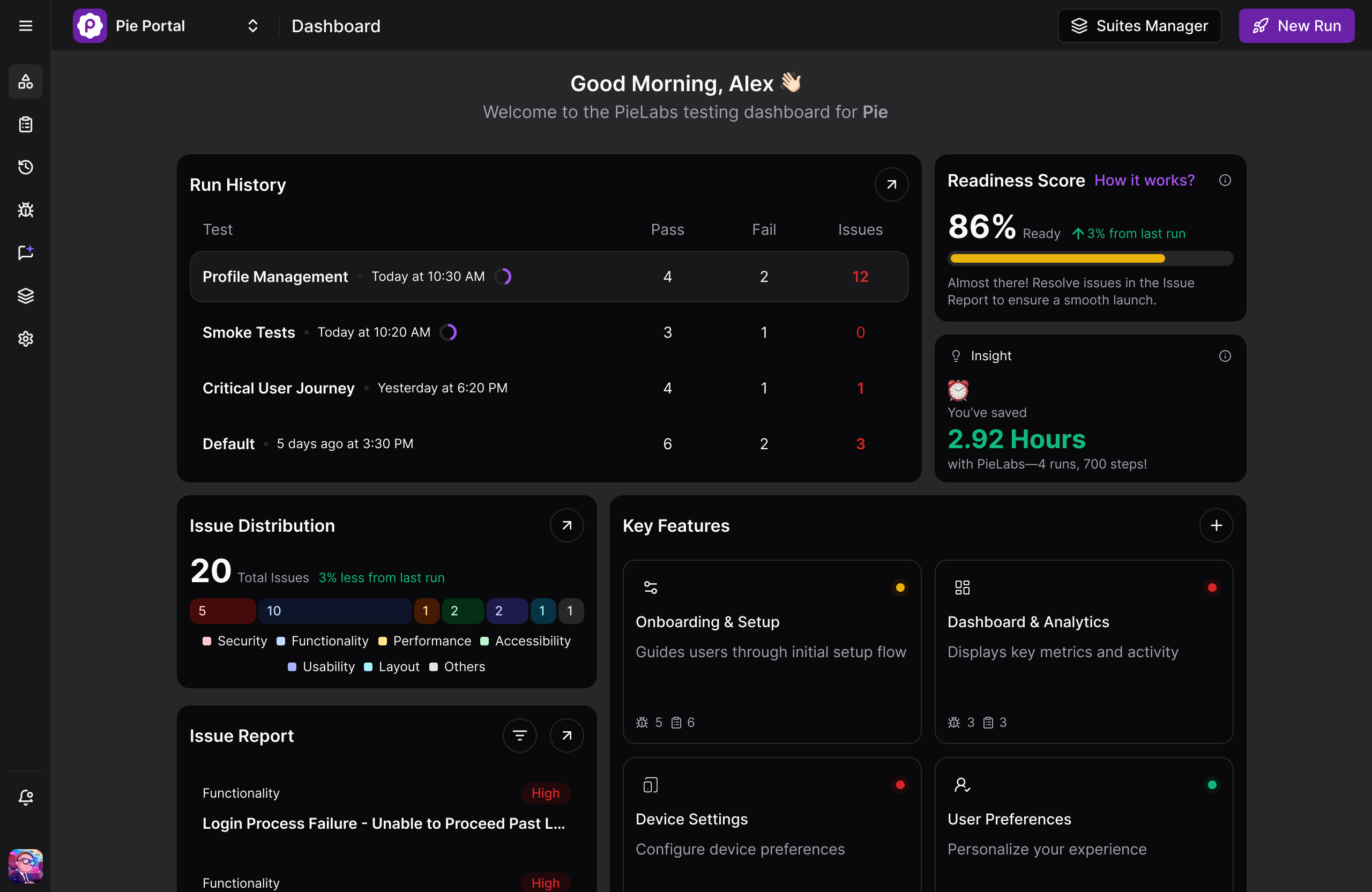
Pie is the autonomous option, and autonomous means something specific here. Point it at your app and hundreds of AI agents explore it the way real users would, map every feature into a knowledge graph, and generate a full regression suite before anyone writes a test. Coverage grows with your codebase, not your headcount.
You are not locked out of authoring, though. When you want to define a specific or edge-case flow yourself, describe it in plain English and Pie builds and runs it, the same natural-language authoring the plain-English AI testing tools are known for. You can also import the tests you already have, in whatever format they live in today. Either way, nobody hand-writes or maintains a selector.
The coverage keeps pace when you ship daily. A button moves or a flow gets reworked, and a selector-based suite turns red; Pie executes by reading the rendered screen instead, so the test stays green and the fix waits on no one. One set of test logic runs across web, iOS, and Android, so there is no second mobile suite to maintain.
Rating: 5.0/5 from 3 reviews on Gartner Peer Insights, an early but perfect score as of mid-2026.
What Pie does differently:
- Autonomous discovery sends hundreds of agents to map your app and generate the baseline suite, with no test written by hand
- Plain-English authoring, via Pie Canvas, for the specific or edge-case flows you want to define yourself
- Imports your existing test cases in any format, so a switch does not start from zero
- Vision-based execution and self-healing, so tests survive redesigns and OS updates without a selector to maintain
- One test definition runs across web, iOS, and Android, with no separate mobile suite
- Pie Loop catches regressions in merged pull requests and opens a reviewed fix before the bug reaches users
Best for: Teams shipping fast, especially with AI writing a chunk of the code, that want coverage to keep pace without a growing contract or a queue for every fix.
Not for: Teams that want to fully outsource QA to a managed services team, or that only need a raw device grid or unit and performance tests.
2. mabl, Low-Code Automation You Own
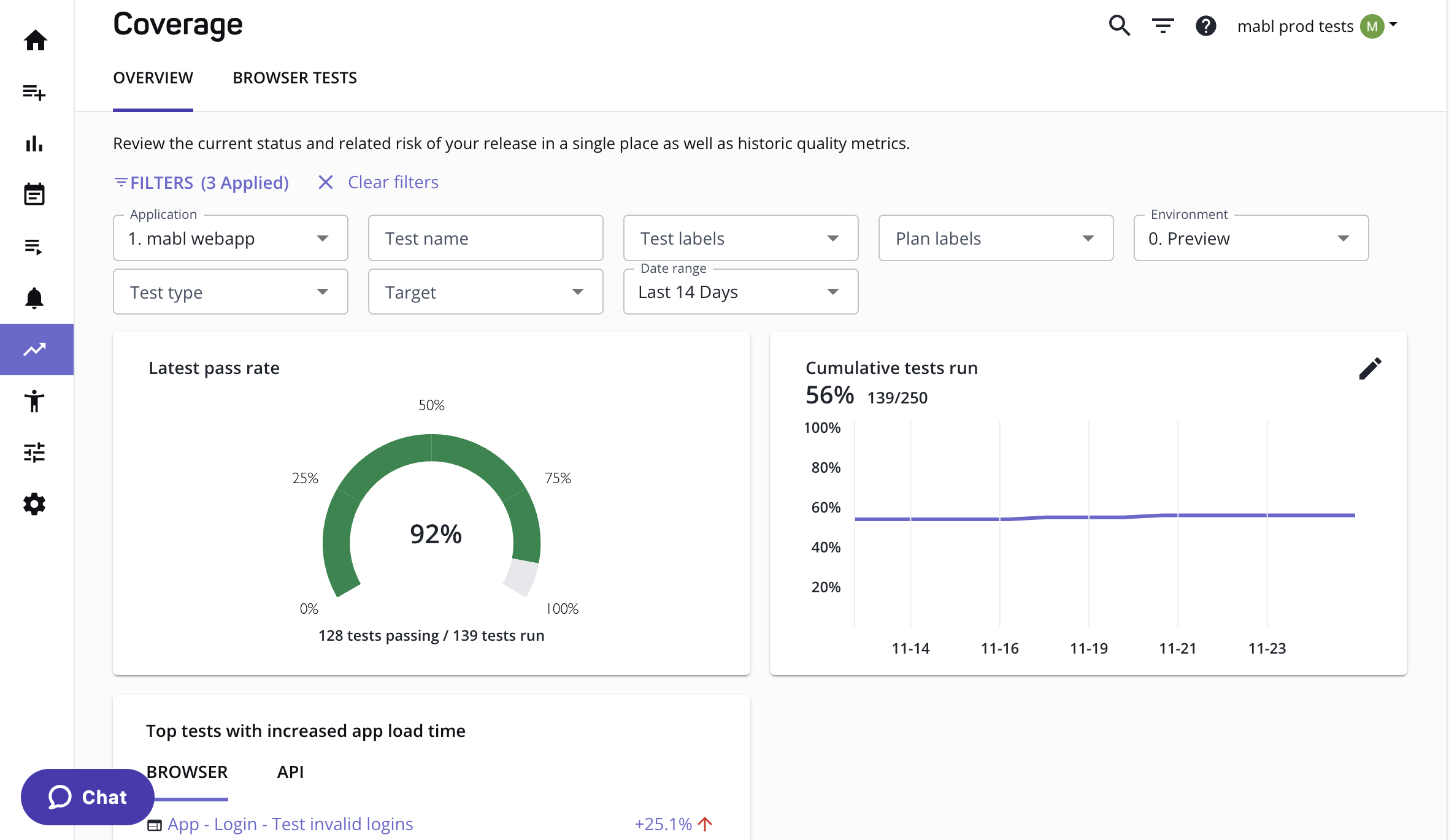
mabl is a low-code, AI-assisted test automation platform your own team drives as a cloud service, with auto-healing that keeps locators working through minor UI changes. It earns its spot by taking you out of the managed-service contract. You own a tool instead of renting a team, so the bill stops scaling with someone else’s headcount. The trade is the work itself, since authoring and upkeep move back onto your plate.
Rating: 4.0/5 from 67 reviews on Capterra, 4.5/5 on G2, as of mid-2026.
Recurring strengths (G2 and Capterra reviewers):
- Auto-healing that keeps tests passing through minor UI changes, cited as the reason teams stopped babysitting Selenium scripts
- Low-code record-and-playback that non-technical QA can pick up quickly
- Fast setup, with reviewers reporting a working test in minutes
Recurring complaints (G2 and Capterra):
- Pricing climbs quickly as test volume grows, which smaller teams feel first
- Cloud execution runs slower than local Selenium, adding lag to CI feedback
- Native mobile coverage is thinner than its web testing
Best for: In-house QA teams that want low-code authoring with auto-healing.
Not for: Teams that want testing off their plate, since you still own authoring and upkeep.
3. testRigor, Plain-English Test Authoring
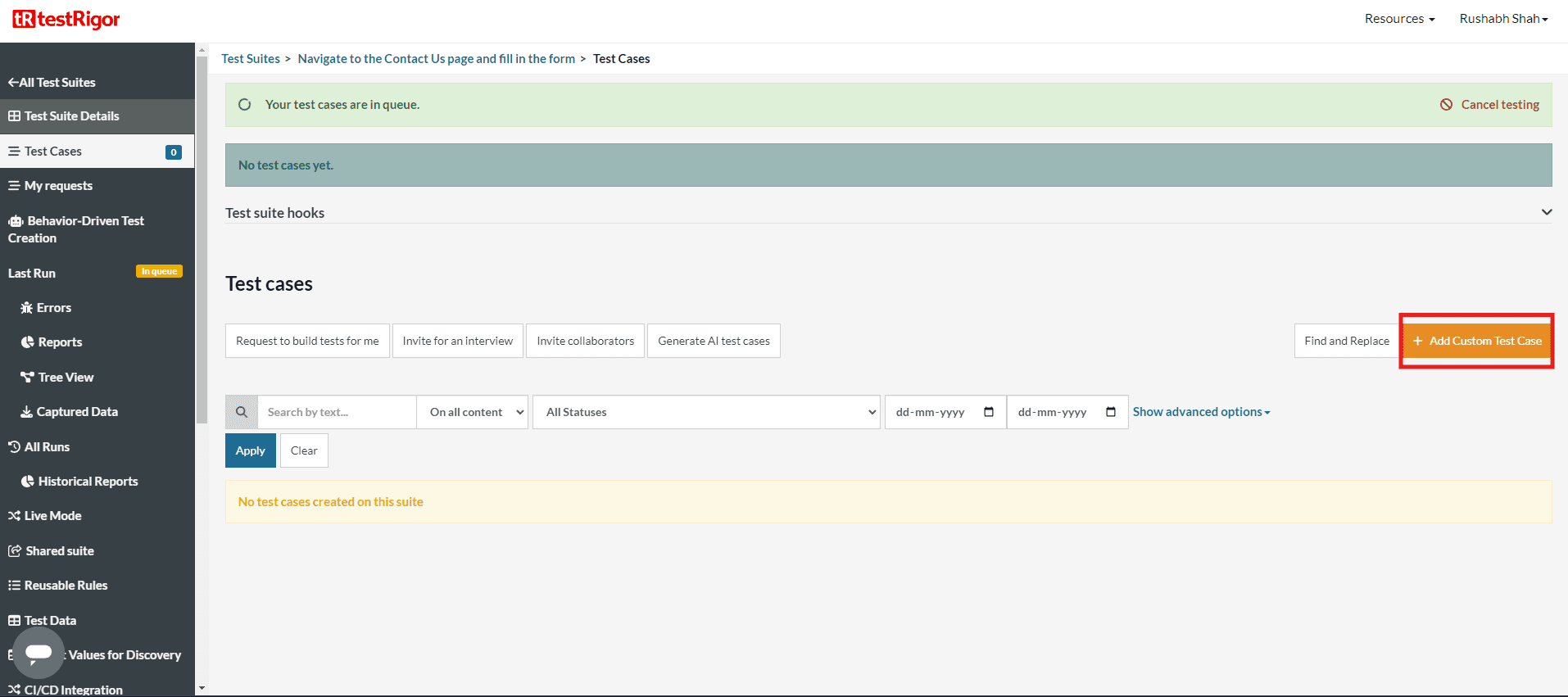
testRigor lets you write tests in plain English, statements like “click Login,” so authoring is open to non-engineers. It goes after the other half of the equation, the wait. Anyone on the team can add or fix a test without queuing behind an engineer, so new coverage stops depending on a single specialist. It is a tool you run rather than a service run for you, which also lands it under QA Wolf on cost. The catch is that a person still authors every test, so that step stays with you.
Rating: 4.6/5 on G2 and Capterra, though the review pools are small, so treat the score as directional.
Recurring strengths (G2 and Capterra reviewers):
- Plain-English authoring that opens test writing to non-engineers
- Low maintenance, because tests are not tied to XPath or CSS selectors
- Responsive, hands-on customer support
Recurring complaints (G2 and Capterra):
- Pricing runs high for smaller teams and scales faster than some expect
- No native test management; it integrates with TestRail, though some teams still fall back to spreadsheets
Best for: Mixed teams where non-engineers write tests in plain English.
Not for: Teams that want tests written for them, or that need built-in test management.
4. Rainforest QA, AI-Driven No-Code Automation
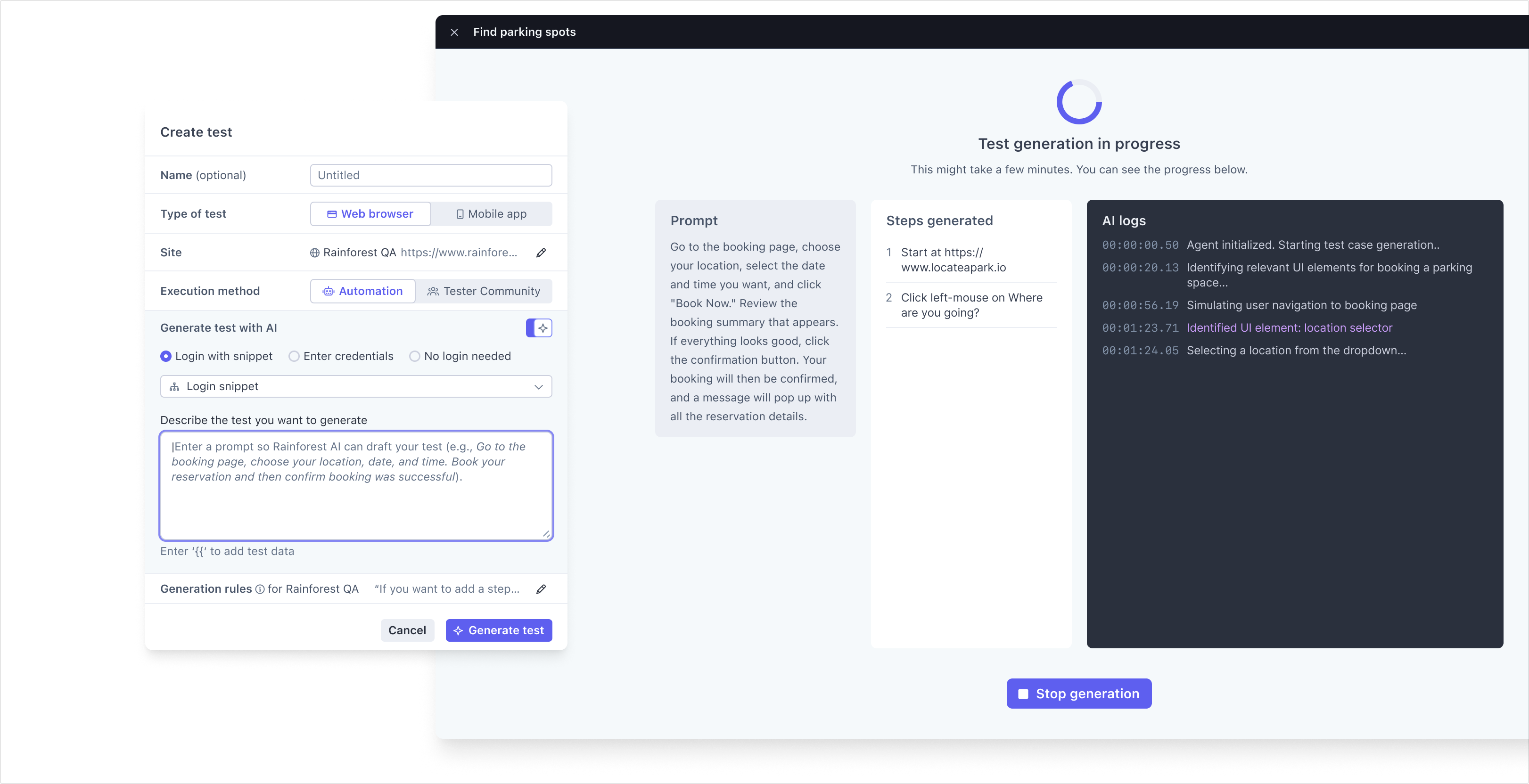
Rainforest QA is an AI-driven, no-code automation platform. You plan and build tests with an AI assistant in a visual editor and run them on Rainforest’s own cloud, with self-healing when the UI shifts. It makes the same ownership trade as mabl from the no-code side, so new tests move at your pace and the bill is a subscription rather than a headcount-linked contract. You own and run the suite inside Rainforest’s tooling instead of handing it to an engineering team.
Rating: 4.3/5 from more than 160 reviews on G2, as of mid-2026.
Recurring strengths (G2 and Capterra reviewers):
- No-code authoring that lets PMs and designers write tests without an engineer
- Responsive, well-regarded customer support
- Quick to a first running test, with no framework to install
Recurring complaints (G2 reviewers):
- Debugging spans several screens, and the reporting is thin for tracking coverage
- Execution slows on large suites, stretching CI cycles once you pass 100 tests
- Cost rises as coverage scales across browsers and environments
Best for: Teams that want no-code, AI-assisted authoring they run themselves.
Not for: Large suites where execution speed and deep reporting matter most.
5. MuukTest, Cheaper Managed QA-as-a-Service
MuukTest is another managed QA-as-a-service, a team plus AI that builds and maintains your end-to-end suite for you. It makes the list because it answers the bill, positioned on a lower price than QA Wolf, while leaving the wait untouched. If you like handing QA off but want a smaller invoice, it is the most direct head-to-head here.
Rating: 4.5/5 from 27 reviews on G2, a small pool as of mid-2026, so read it as directional.
Recurring strengths (G2 reviewers):
- Cuts the manual testing done before each release, without adding headcount
- Hands-on partnership, with a dedicated project manager and QA contact
- Frees the in-house engineering team to focus on core product work
Recurring complaints and structural limits:
- Getting started takes real upfront investment, with entry pricing reported around $5,000 per month
- A short learning curve as you find your way around the app, per a small review pool
- As a people-run service, turnaround and visibility stay bounded by the vendor’s team, the same ceiling any managed model hits
Best for: Teams that want QA Wolf’s outsourced model at a lower price.
Not for: Teams shipping daily that need fixes faster than a human team can turn around.
6. BrowserStack, Infrastructure and Breadth
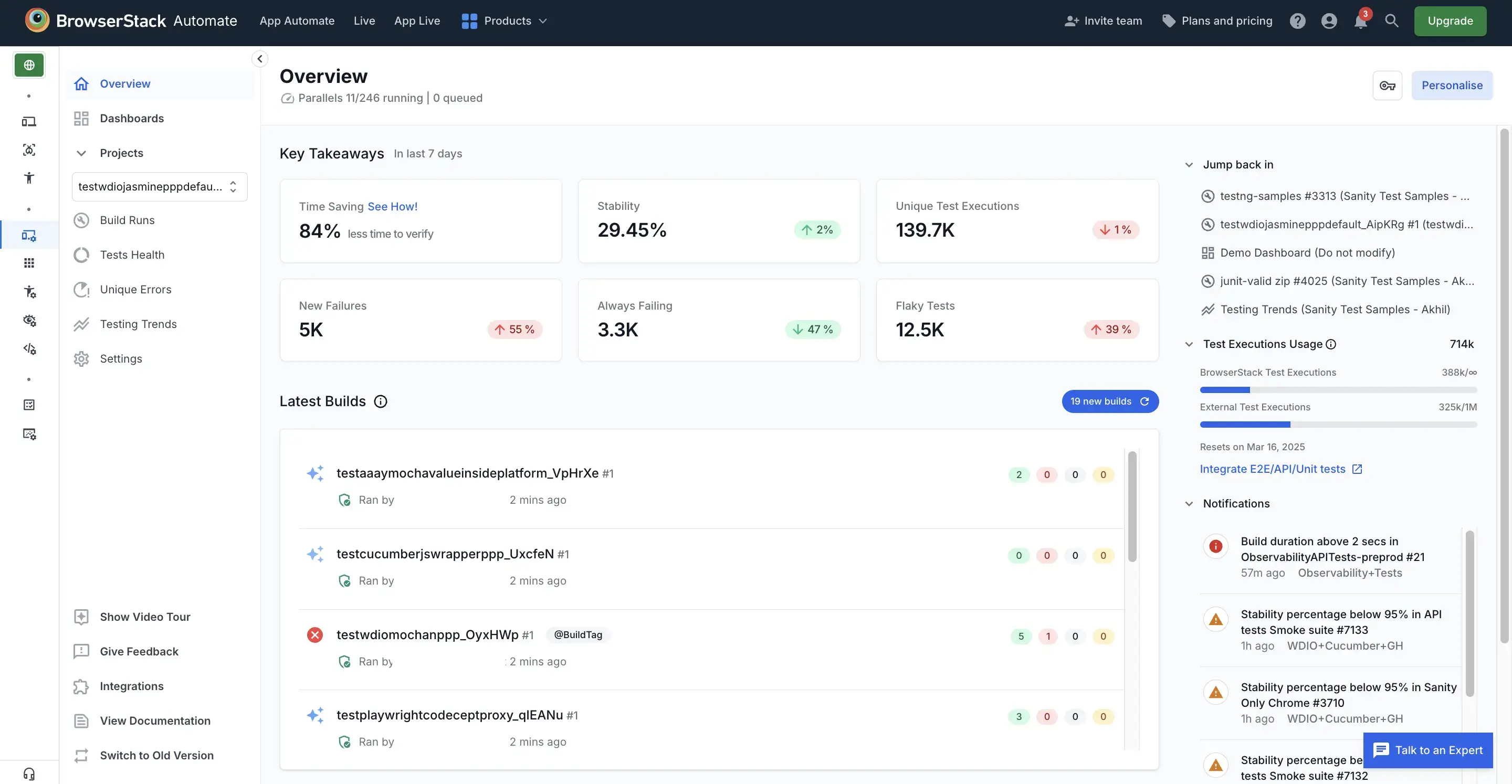
BrowserStack is testing infrastructure, thousands of real devices and browsers with low-code tooling on top. It is on this list for a different reason than the rest, because it does not take on the authoring-and-maintenance work at all. Some teams who shortlist QA Wolf really need coverage across environments more than they need someone to write tests, and that is the shortfall BrowserStack fills. You still own the authoring and the upkeep.
Rating: 4.5/5 from more than 2,600 reviews on G2, as of mid-2026, reflecting its strength in device and browser variety.
Recurring strengths (G2 and Capterra reviewers):
- A huge matrix of real devices and browsers on demand, with no physical lab to maintain
- Runs your existing Selenium, Cypress, and Appium scripts, with smooth CI/CD integration
- Real cost and time savings against buying and maintaining your own devices
Recurring complaints (G2 and Capterra):
- Cost climbs fast with parallel sessions and at scale
- Real-device sessions can lag or turn flaky at peak, with queues for popular devices
- A learning curve and config quirks for advanced setups, with uneven documentation
Best for: Teams whose real need is device and browser breadth, not authoring.
Not for: Teams whose bottleneck is writing and maintaining tests, not device access.
7. Autonoma, Source-Available and Self-Hosted
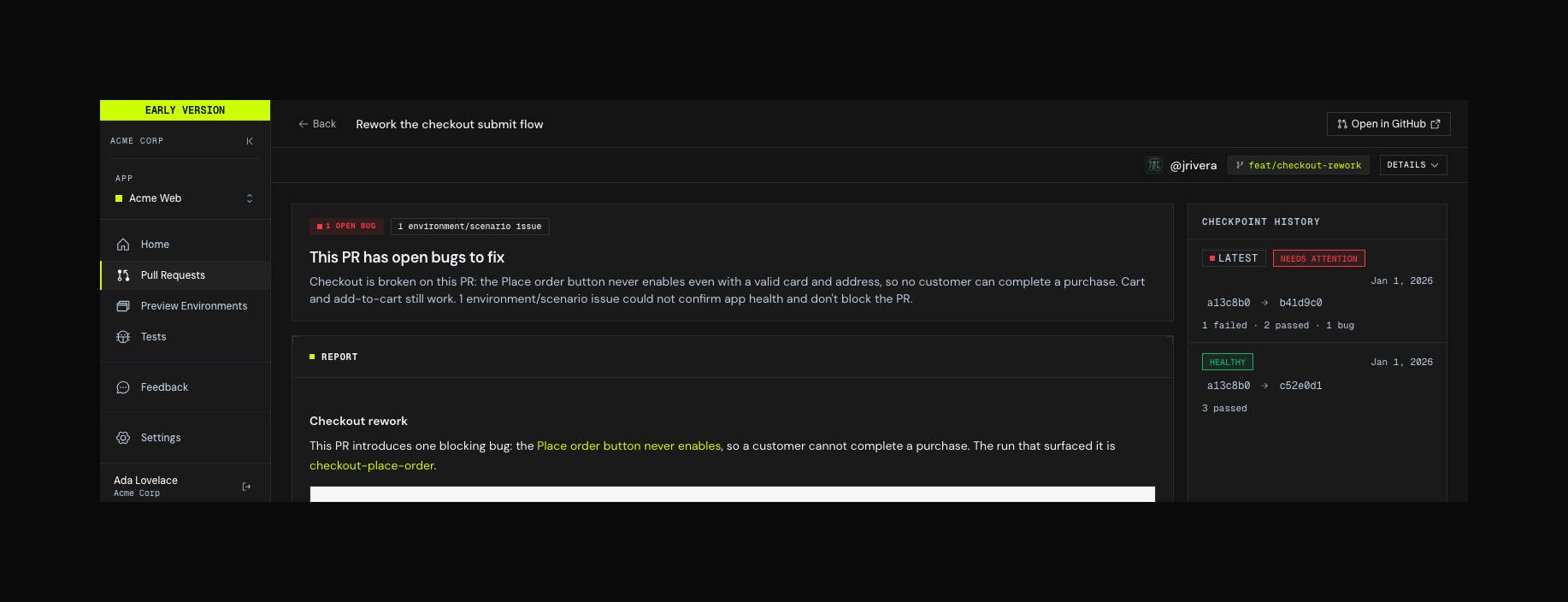
Autonoma is a source-available platform where AI agents generate and maintain the tests on their own, matching to the app by what the screen shows rather than to selectors. It takes the same software-first route as Pie, then hands you the keys to run it. You can self-host the whole platform for the cost of your own infrastructure, or run its managed cloud instead. The trade is the operational load. Self-hosting an AI testing platform is real infrastructure work your team signs up for.
Rating: No G2 or Capterra review profile yet, as of mid-2026, so weigh it on its product and its public GitHub activity rather than on aggregate scores.
Strengths (from Autonoma’s own platform):
- Identifies elements by what the screen shows and self-heals when the UI moves, so tests are not tied to selectors
- Free to self-host with no feature limits, so you only pay for your own infrastructure
- Or run its managed cloud, which starts free and bills by usage with no minimum
Trade-offs:
- Self-hosting is real operational work. The platform is Kubernetes-native, so you run and maintain the cluster, browser containers, storage, scaling, and security updates yourself
- It is source-available under a Business Source License rather than fully open source, and no team runs it for you unless you choose its managed cloud plan
Best for: Engineering teams that want an autonomous stack they self-host and control.
Not for: Teams without the ops capacity to run a self-hosted Kubernetes stack.
Coverage That Scales With Code
Point Pie at your app. Watch it build the suite and keep it green on its own.
Book a DemoHow to Choose Your QA Wolf Alternative
One question sorts this market. Who, or what, maintains your tests over time? Authoring a test is a one-time cost. Maintaining it is forever. Answer these four in order and your winner falls out.
- Own it, outsource it, or automate it? Owning a low-code or plain-English tool like mabl, testRigor, or Rainforest QA still means your team writes and maintains the tests, just with more help. Outsourcing to a services team like QA Wolf or MuukTest hands off the work but caps speed at human throughput. Automating it in software, with Pie or self-hosted Autonoma, removes the authoring and the upkeep.
- How fast does your product change? Ship daily and a human-bounded service will lag you. An autonomous platform like Pie keeps pace because coverage scales with code, not people, through autonomous test discovery that runs on every build.
- What is your real budget at scale? A managed contract that grows with the suite looks fine at 100 tests and heavy at 1,000. Model the cost at your two-year test count, not today’s.
- Do you ship web, mobile, or both? Separate suites for web and native mobile double the maintenance. Pie runs one behavior-based definition across web, iOS, and Android, so a single suite covers all three.
Want to put a number on it? Our test maintenance cost calculator breaks down where the money actually goes after the tests are written.
Managed vs In-House vs Autonomous QA
Strip it down and every option answers one question, who writes and maintains the tests, in one of three ways.
| Model | Who writes and maintains tests | How cost and speed scale | Examples |
|---|---|---|---|
| Managed QA | A services team, for you | With the team behind your account | QA Wolf, MuukTest |
| In-house automation | Your team, with low-code or AI help | With your headcount and hours | mabl, testRigor, Rainforest QA |
| Autonomous QA | AI agents, no hand authoring | With your codebase, roughly flat per test | Pie, Autonoma |
The model decides how cost and speed behave as you grow, and who is on the hook when the UI changes. Managed and in-house both scale with people, whether the vendor’s or your own. Autonomous QA scales with the code, so your thousandth test costs about what your hundredth did. Pie reads the rendered screen instead of binding to selectors, so the tests do not rot, and selector rot is the maintenance liability that makes large automated suites expensive over the years.
”The time between having a release candidate ready and being fully tested has gone from two to three days to a few hours.”
— Philip Hubert, Director of Mobile Engineering, FiRead the full Fi case study.
Stop Waiting on a Human to Fix Your Tests
When your team ships faster with AI, the constraint moves downstream to QA. QA Wolf was built for the era when the fix was to hire a services team to write the tests.
It still works. But the coverage rides on a contract that grows with your suite, and every fix waits on that team. When releases go daily, a services team in the critical path is the new bottleneck.
So go back to the one question. When your app changes at 5pm on a release day, who fixes the broken tests, and how long do you wait? Pie’s autonomous QA platform already did, before you noticed.
Stop Waiting on QA
Hand Pie your app and watch it keep coverage green on every build, no services team required.
Book a WalkthroughFrequently Asked Questions
Spent a decade in B2B SaaS sales before building Pie. Now obsessed with helping engineering teams ship without the fear of breaking things. LinkedIn →