Why Test Debt Costs More Than Tech Debt (and Nobody Tracks It)
Tech debt has a ticket. The coverage you skipped has nothing, and it compounds on every deploy. Why test debt is the more expensive loan, and how to pay it down.

Your board has a column for tech debt. Someone put it there, and every so often it wins a Friday afternoon. Now go find the column for test debt. It isn’t there. Nobody opens a ticket for the tests they skipped to make the date, or for the suite that went flaky and got muted.
Tech debt is a mortgage, a payment you can see and plan around. Test debt is an overdraft you never signed up for, and you learn the balance the day a release breaks in front of a customer. The untracked loan compounds faster, and paying it down does not mean freezing the roadmap. If your board has one column and not the other, this is the case for adding the second.
What you’ll learn
- What test debt is, and why it is not the same thing as technical debt
- Why the tests you skip compound faster than the refactors you skip
- Where the bill actually lands, from flaky suites to production bugs
- How to pay test debt down without freezing feature work for a month
What Is Test Debt?
Test debt is the accumulated cost of coverage you never wrote, plus coverage you wrote and then stopped maintaining. Every “we’ll add it next sprint” is a withdrawal against future confidence. So is every muted flaky spec. A little is fine, the same way a little of any debt is fine. Left unpaid, it is the reason you can no longer tell whether a release is safe.
The framing is borrowed on purpose. Ward Cunningham described shipping first-time code as going into debt in his 1992 OOPSLA report, a small loan that speeds you up “so long as it is paid back promptly with a rewrite.” His warning was about never repaying it. Test debt is the same loan taken against a different asset. Instead of borrowing against code quality, you are borrowing against your ability to change anything safely.
The difference that matters is visibility. Bad code announces itself. You feel it every time you open the file. Missing coverage says nothing at all. The flow works today, the demo passes, the gap goes unnoticed, and the balance sits quietly on the books until an untested change reaches a customer.
Technical debt makes code harder to change. Test debt makes you afraid to change it at all, because nothing will tell you what you broke.
Why Test Debt Compounds Faster Than Tech Debt
Technical debt is local. Test debt is systemic. A messy module slows down work in that module, and you can quarantine it or budget a sprint for it. A missing test raises the risk of every change everywhere, because without coverage you cannot confirm that a fix in one corner did not quietly break a flow three modules away. The interest is charged on every deploy, whether or not that deploy touches the code you skipped.
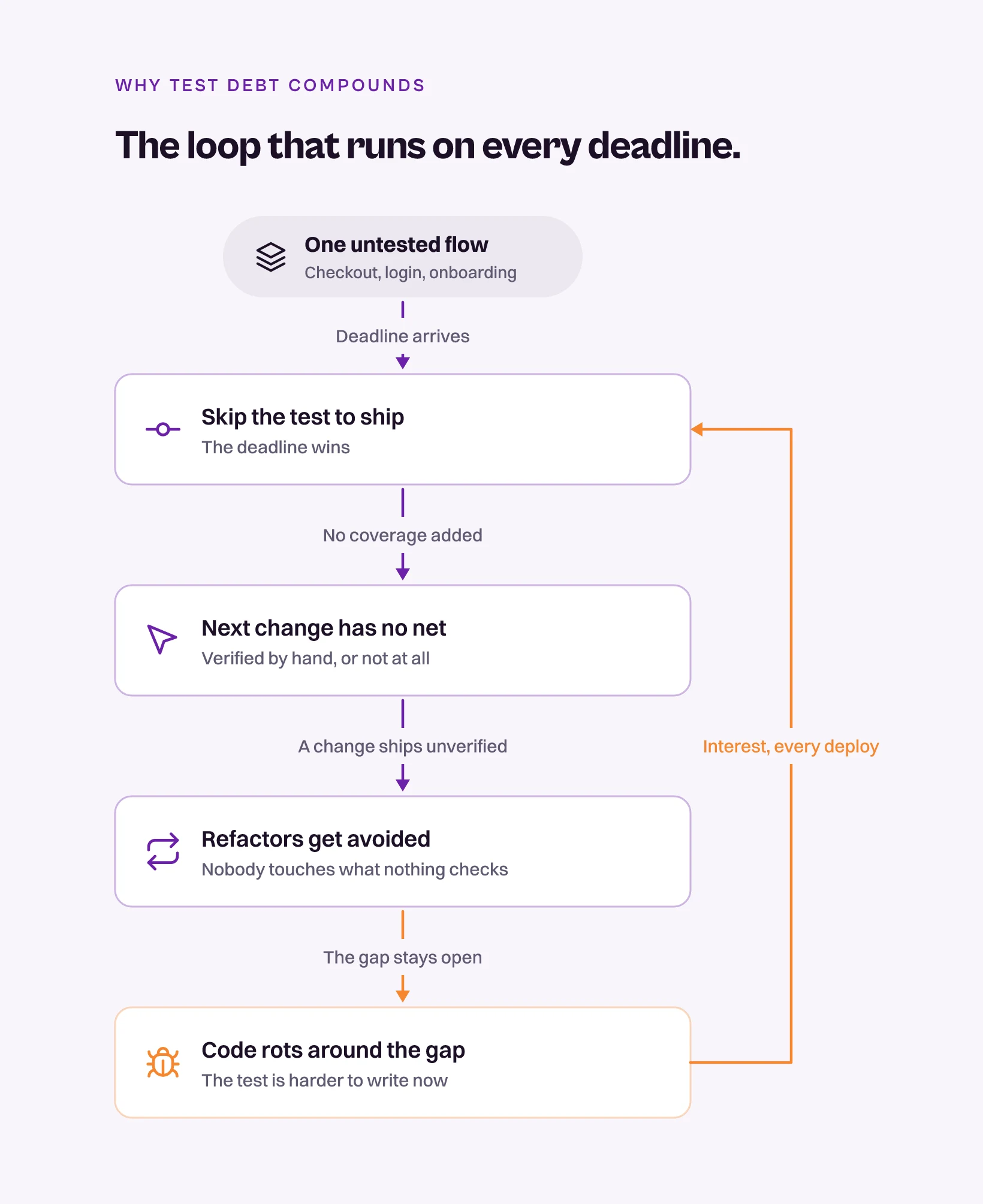
The loop runs like this:
- You skip a test to ship. The deadline is real and the test is not, so the test loses.
- The next engineer inherits no safety net. They verify the change by hand, or they don’t.
- Confidence drops, so refactors get avoided. No engineer restructures code they cannot prove still works.
- The code rots around the gap. Now the missing test is harder to write than it was last quarter.
- The next test gets skipped. Same reasoning, worse starting position.
Each untested change makes the next one scarier. The curve bends upward instead of running flat.
Flaky tests are the same debt wearing a disguise. Atlassian published its own numbers in December 2025. Roughly 15% of failures in the Jira backend repo trace to flaky tests, and the reruns burn more than 150,000 developer hours a year. That is at a company with a dedicated tool for catching them.
Once a team stops trusting red, they start ignoring it, and a test nobody trusts is functionally a test that does not exist. You paid to write it and you keep paying to run it. A coverage report counts those flaky tests anyway. Your engineers stopped counting them a long time ago.
The loop also got faster. The pattern we hear on calls barely varies. A team gets a suite written, often with AI help, and then the product changes. Selectors move and tests flip to flaky. The first thing cut in a velocity crunch is updating them. Swaths of the suite go out of date, and the fallback becomes manual testing, because by then it is the one way left to verify a release.
More code is arriving faster than anyone is checking it, and the only thing that turns a pile of changes into a release decision is coverage. Coverage is the account you have been borrowing against.
Where the Test Debt Bill Actually Lands
Test debt never sends an invoice. It always gets collected. By the time it does, the deadline you saved by skipping the test is three quarters in the past and the two events never get connected.
The bill is denominated in engineer hours. Some of those hours are unavoidable. A large slice of them is people re-verifying by hand what a suite they trusted would have confirmed while they slept, and that slice never shows up as a line item because it is never measured.
The automation you did build is not free either. Propping up brittle tests as the app changes underneath them is the cost of maintaining tests, and it is test debt filed under a different account name. Call it test automation debt, coverage that exists on paper and costs an engineer every sprint to keep true.
Where it surfaces, concretely:
- Flaky suites nobody trusts: Red stops meaning broken, so real regressions slip through with the noise.
- Releases measured in days, not hours: Each ship needs a manual pass, because the safety net has holes and everyone knows roughly where.
- Bugs in production: The most expensive place to find a defect is the one place test debt guarantees you will.
Tech Debt vs Test Debt, Side by Side
Both are loans. They behave differently on almost every axis that matters, which is most of the reason one gets managed and the other gets ignored.
| Dimension | Technical Debt | Test Debt |
|---|---|---|
| Visibility | Named and labeled, on the board | Invisible until a release breaks |
| Who tracks it | Engineers, in the backlog | Usually no one |
| How it shows up | Slower to change one area of code | Riskier to change anything, anywhere |
| How it compounds | Roughly linear, stays local | Compounds on every deploy, spreads system-wide |
| When the bill arrives | Gradually, as developer friction | Suddenly, in production, with customers watching |
| How you pay it down | Refactor the code once | Add coverage, then keep it alive as the UI changes |
The last row is the quiet killer. Refactor a module and that technical debt is retired for good. Write a test against a UI that changes next month and you have bought yourself a recurring payment. Refactoring retires tech debt. Coverage rolls it over. It explains why teams who “have tests” keep finding test debt, and why the size of a suite tells you almost nothing about the safety it buys.
How to Pay Down Test Debt in Five Steps
Nobody stops shipping for a month to write tests, and nobody should. Freezing features to buy coverage swaps one debt for another, and the second one has customers attached. Manage test debt the way you would manage any loan. Make it visible, stop it growing, then pay down the highest-interest balance first.
- Make it visible: Line coverage tells you how much code ran, not whether your product works, which is why code coverage is a vanity metric. Track critical-flow coverage instead. Which of your revenue and retention paths (checkout, login, onboarding, the actions that define your product) have a reliable automated test, and which do not.
- Stop the bleeding: Gate new critical flows so no feature ships without coverage. Debt you stop adding is debt you can get ahead of.
- Pay down by risk, not by file: Cover the flows whose failure costs the most first. A broken checkout is a revenue event. A broken settings toggle is a Tuesday.
- Kill the maintenance tax: Coverage decays into debt because brittle selectors break whenever the UI changes. If your tests need a human to repair them each sprint, you are refinancing the debt rather than paying it off. Self-healing tests adapt when the button moves instead of failing, so the coverage you already paid for keeps working.
- Automate the gap-finding: Documenting every untested flow by hand is its own manual tax, and it is the step most teams never finish. Autonomous discovery explores the app the way a user would and produces the coverage map for you, so paying down debt does not start with a week of spelunking.
The teams who get ahead of this are not the ones with the most tests. They are the ones whose coverage keeps up with the product without a growing repair bill. Fi moved that work onto Pie so the engineers who had been running release validation by hand could get back to building.
None of that removes one step. Somebody who understands the business still has to rank the flows, because autonomous QA can tell you what is untested and it cannot tell you what a broken signup costs you the week before a launch. Finding the gaps and repairing the tests is the grunt work. The ranking is judgment, and it stays with your team.
Put the Invisible Debt on the Board
Every skipped test is a loan with the terms hidden, and you repay it with interest the first time an unverified change reaches production. Tech debt at least shows up somewhere you can argue about it in public. Test debt stays off the books until it is a customer-facing incident.
Put it on the board, then stop paying the maintenance tax that turns yesterday’s coverage into tomorrow’s debt. Coverage that finds its own gaps and repairs itself as the app changes is how the balance stops growing while nobody is looking. We started Pie because keeping a suite alive should not be a full-time job for the people you hired to build things.
So go find the column. Which of your critical flows would you bet a release on tonight, and who would you have to ask to be sure?
See What You're Not Testing
Point Pie at your app. Get back the flows you never covered.
Book a DemoFrequently Asked Questions
Test debt is the accumulated cost of coverage you never wrote, plus coverage you stopped maintaining. Every feature shipped with a promise of tests later adds to it.
A little is fine if you pay it back quickly. Most teams never track it, so it surfaces when a release breaks.
No. Technical debt is messy code that is harder to change. Test debt is missing or unreliable coverage, so you cannot tell whether a change is safe.
Test debt is the more dangerous because it is invisible. Tech debt gets a place on the board. Test debt rarely does.
Technical debt slows down the code it lives in. Test debt raises the risk of every change, because nothing confirms that a fix in one place did not break another.
Each untested flow makes the next change scarier, so refactors get avoided and the interest is charged on every deploy.
It shows up as flaky suites nobody trusts, releases that take days because everything needs a manual pass, and bugs that reach production.
At the team level the bill is engineer hours spent re-verifying by hand what a trusted suite would have confirmed automatically, and that time is rarely measured.
Measure critical-flow coverage instead of line coverage. Ask which revenue and retention paths have a reliable automated test and which do not.
A flow with no test, or a test so flaky nobody trusts it, is debt. Autonomous discovery can explore your app and produce that gap map.
Gate new critical flows so the debt stops growing, then pay down the gap by risk rather than by file, most expensive failure first.
Coverage you cannot maintain becomes debt again on the next UI change, so the durable fix is tests that adapt instead of breaking.
Test debt has two sources, the coverage you never wrote and the coverage that broke. Pie works on both.
Our agents explore the app and generate coverage without an engineer scripting each flow, and self-healing tests adapt when the UI changes. Ranking the flows stays your team's call.
Spent a decade in B2B SaaS sales before building Pie. Now obsessed with helping engineering teams ship without the fear of breaking things. LinkedIn →