Zero-Maintenance QA Automation: An Engineering Leader's Guide
Why vision-based autonomous agents are the only way to scale QA in 2025. Learn how to escape selector hell and achieve 80% coverage in weeks, not years.
Abstract
For the last decade, engineering teams have been sold a lie: that if you write enough Selenium scripts, you will eventually achieve stability. Here's the reality: it's all just a maintenance trap. According to the World Quality Report 2025, despite massive investment, the average organization has automated only 33% of their test cases.
This paper analyzes why selector-based automation is mathematically impossible to scale in modern CI/CD environments and introduces the AI-Native architecture that replaces it. We move beyond "AI-assisted scripting" to true Autonomous Quality.
Executive Summary
The Coverage Illusion
If you ask a VP of Engineering how their automation is going, they'll tell you they have 80% coverage. If you look at their commit history, you'll see their senior engineers spending 30% of their week fixing tests that broke because a <div> changed to a <span>.
We call this the Maintenance Trap.
Traditional automation tools (Selenium, Appium, Playwright) were built for a static web that no longer exists. They rely on the DOM—hunting for rigid identifiers like xpath //div/button[2]. Modern frameworks like React and Vue, however, generate dynamic DOMs where IDs change with every build.
The Industry Reality (Data from WQR 2025)
The World Quality Report 2025 paints a stark picture of the current state of QA:
- Stagnation: The average test automation levels have stalled at 33%.
- The Skill Gap: 56% of organizations report fragmented strategies and skill gaps as major blockers.
- The AI Struggle: 64% of teams cite "difficulty integrating Gen AI tools into existing workflows" as their top challenge.
The Pivot: These failures share a common root cause. Teams are still telling computers HOW to test instead of WHAT to test.
"We didn't build Pie because we wanted better scripts. We built it because we realized that asking humans to write code to test code is a recursive loop of failure. The only way to win is to remove the script entirely."
— Dhaval Shreyas, Founder & CEO, Pie
The Root Cause
Why Selectors Fail at Scale
The fundamental flaw in traditional QA is Selector Dependency.
When a human tester looks at a login screen, they see a "Login Button." They don't care if the button is named #btn-submit-01 or .css-class-primary. They understand the intent of the element based on its visual context.
Scripts are blind. They rely entirely on the underlying code structure, creating a predictable failure pattern.
The Brittleness Cycle
- Code Change: A developer updates the UI library. Button classes are regenerated.
- Test Failure: The script looks for
#submit, finds nothing, and crashes. - False Positive: The app works fine for the user, but the build is blocked.
- Maintenance Debt: An SDET spends 4 hours rewriting the script selectors.
The "Script Sprawl"
Script sprawl compounds the original problem. Instead of testing the application, engineers maintain the testing framework. The automation meant to accelerate delivery becomes the bottleneck.
Here's the industry data which validates this failure pattern.
WQR Validation: 50% of organizations explicitly cite "maintenance burden and flaky scripts" as their primary automation challenge.
Internal Data: Pie's discovery data reveals that mid-sized enterprise teams spend 20-40 hours per month merely maintaining existing suites—debugging flaky tests and updating broken selectors.
The Innovation
Architecture: Vision-Based Autonomous Agents
Pie rejects the DOM-first approach. We built an AI-Native platform that tests at the UI layer the same way a human user does. Learn more about our vision-based testing approach. Three core innovations make this possible.
1. The Contextual Model
Instead of parsing code, Pie's AI agents perform an autonomous crawl of your application. They navigate every screen, identify interactive elements, and map user paths. This creates a Contextual Model—a structured understanding of your app's features. The AI doesn't just see a button; it understands that "this button leads to the Checkout flow."
2. Vision Over Selectors
Pie uses computer vision to identify elements.
- Traditional: Click element at
#login-btn - Pie Agent: Find the 'Login' button and click it.
If the underlying code changes but the button still looks like a login button to the user, the test passes. Self-Healing by design, not as an afterthought.
3. Hybrid AI Engine
We don't rely on a single generic LLM. Pie uses a fleet of specialized AI modules (built in Go) designed for distinct purposes: discovery, execution, and bug analysis.
"Generative AI is great for creativity, but QA requires precision. That's why we use a hybrid architecture. Classical machine learning handles the control systems and accuracy, while GenAI handles the semantic understanding of the UI. It's the best of both worlds—creative exploration with deterministic execution."
— Adithya Aggarwal, Founder & CTO, Pie
The Workflow
The 3P Framework: Push, Probe, Pass
We simplified the E2E process into three autonomous steps. No IDEs, no SDKs, no instrumentation. See the full workflow on our product page.
Step 1: PUSH (Zero Integration)
You don't need to alter your source code or install an SDK.
- Web: Provide a URL.
- Mobile: Upload the .apk or .ipa build file.
- Auth: Provide test credentials if behind a login wall.
- Time: < 2 minutes.
Step 2: PROBE (Parallel Execution)
This is where the fleet of agents takes over.
- Deep Discovery: Agents crawl the app to build the map.
- Test Generation: Based on the map, the system generates hundreds of relevant E2E tests covering functionality, performance, and edge cases.
- Parallelization: Tests run simultaneously across isolated cloud devices.
- Time: 15–30 minutes.
Step 3: PASS (The Readiness Score)
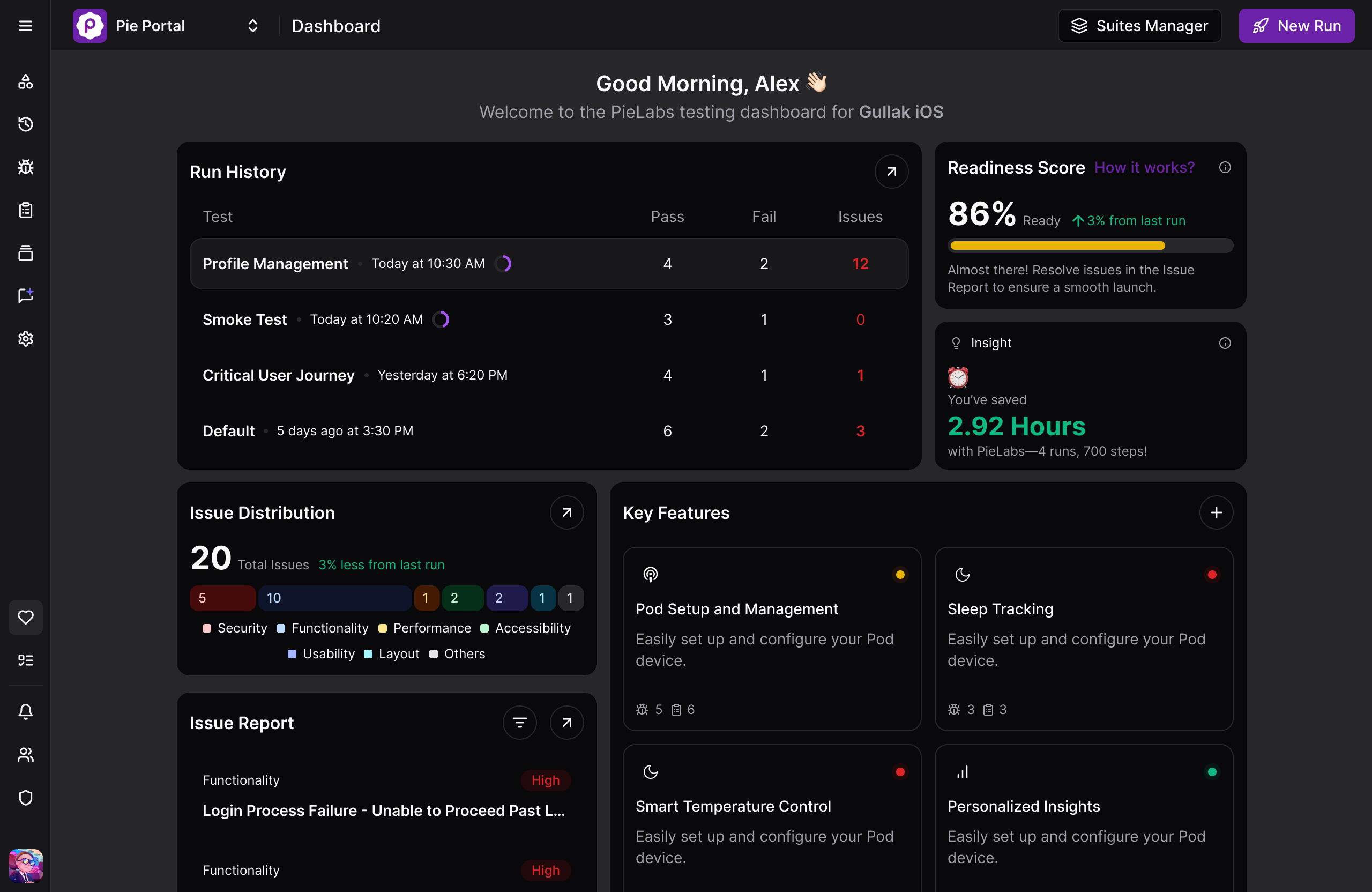
The output isn't a list of "failed scripts." It's a Readiness Score (0-100%) that tells you if the build is safe to ship.
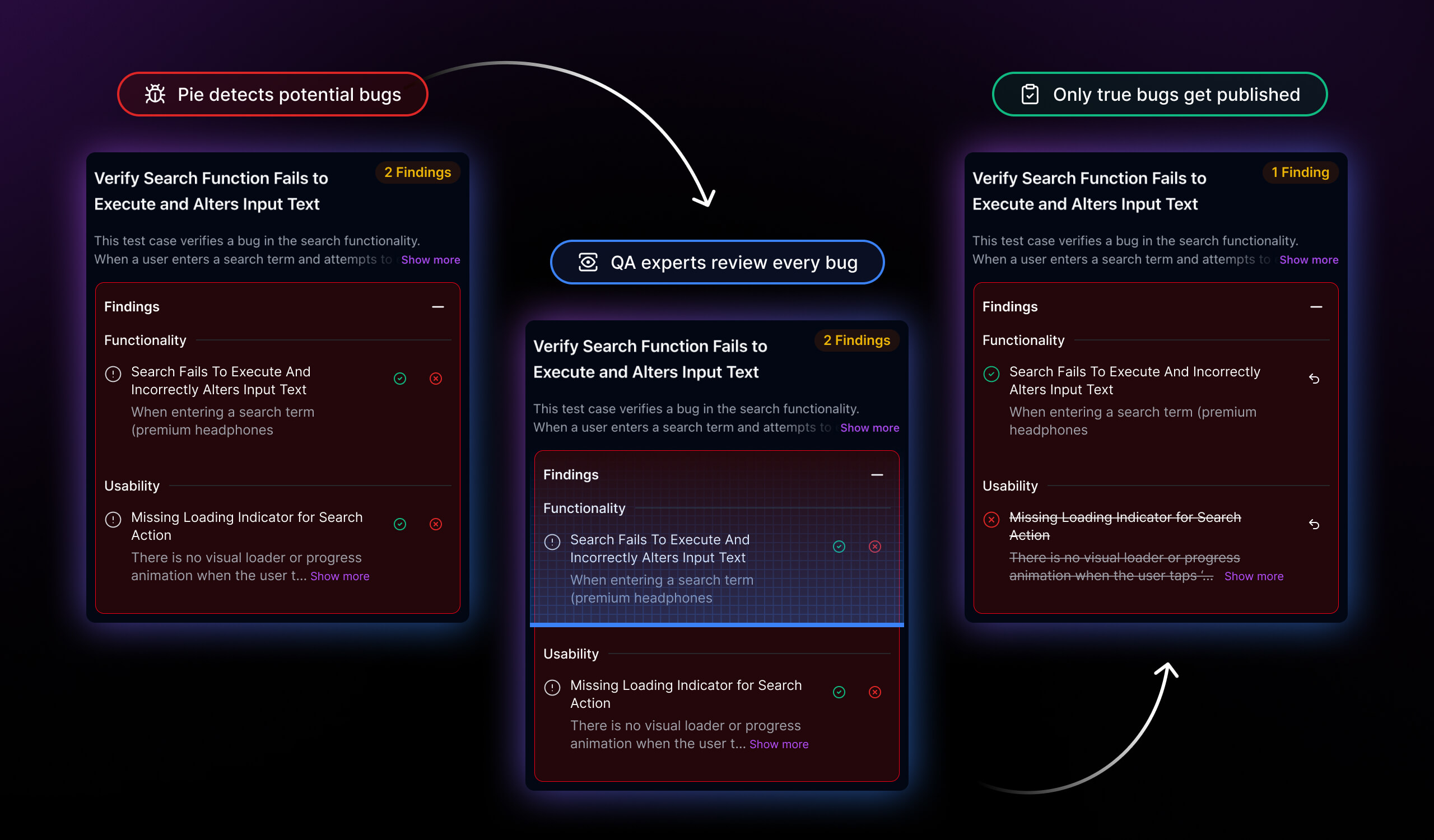
- Findings vs. Issues: The AI intelligently clusters raw findings. If a navigation error causes 50 tests to fail, you get one Issue report, not 50 alerts.
- Visual Proof: Every issue comes with a video replay and step-by-step reproduction instructions.
- Time: Results available almost immediately after Probe completes.
Case Study
How Fi Slashed Release Cycles from Days to Hours
The Client: Fi (Series B, Consumer IoT / Smart Dog Collar)
The Stakes: Reliability isn't optional for GPS tracking that millions depend on. Release validation demands rigor to maintain the safety standards their customers trust.
The Problem: Release validation consumed significant engineering resources and extended release cycles across multiple devices and configurations.
Fi needed a solution that could scale with their device matrix without scaling their QA headcount.
The Pie Solution
- Fi integrated Pie into their pipeline. Now, every code push triggers an autonomous run.
- Setup: Zero architecture changes. Pie simply plugged into the existing build process.
- Coverage: Expanded from basic smoke tests to complex edge cases without writing scripts.
The Results
"The delta between our system detecting something and informing the customer should be almost instantaneous. Reliability amidst that is critical."
— Philip Hubert, Director of Mobile Engineering, Fi
The Economics
Calculating the "Innovation Tax"
The most expensive tool in your stack isn't the one you pay a subscription for; it's the "free" open-source tool (Selenium/Appium) that consumes 30% of your engineering capacity.
The "Incremental Gains" Trap
The World Quality Report 2025 notes that organizations using GenAI for testing report an average productivity improvement of just 19%. These teams use AI to write scripts faster—accelerating a broken process that still requires constant maintenance.
The Pie Differential: Pie doesn't offer 19% productivity gains. Our vision-based testing delivers zero-maintenance scaling—new features generate zero new test scripts.
- Manual/Scripted QA: Linear scaling. 100 new features = 100 new scripts = 100 new maintenance points.
- Autonomous QA: Zero marginal maintenance. 100 new features = The agent learns 100 new paths automatically.
This economic difference compounds over time. Most engineering leaders underestimate the true cost until they calculate it.
Calculate Your Team's Maintenance Tax
Most engineering leaders underestimate the hidden cost of test maintenance.
Use our interactive calculator to find out how much you're spending →
Security & Compliance
Economic advantages mean nothing if enterprises can't trust the platform with their applications. Security and compliance requirements make or break enterprise adoption.
The Enterprise Trust Layer
The World Quality Report 2025 identifies Data Privacy (67%) as the #1 concern for AI adoption in testing. Enterprises are terrified of leaking IP to a "Black Box" model.
Pie's architecture was built specifically to neutralize this threat.
1. The "Zero Source Code" Protocol
Most AI coding assistants (Copilot, Cursor) require read-access to your codebase. Pie does not.
- We test at the UI Layer.
- We do not ingest, store, or train on your private repository.
- Our agents see exactly what your user sees: pixels on a screen. This eliminates the vector for source code leakage entirely.
2. Isolated Ephemeral Environments
We do not use shared runners. Every test run executes in a completely isolated, sandboxed cloud environment.
- Lifecycle: Spun up on-demand, destroyed immediately after execution.
- Guarantee: Zero data cross-contamination between test runs or different customers.
3. Enterprise Standards
- SOC 2 Type 2 Compliant: Verified security controls.
- GDPR Ready: Compliant data handling for EU markets.
- Encryption: TLS 1.2+ in transit, AES-256 at rest.
- RBAC: Granular role-based access control to ensure only authorized personnel see sensitive test results.
Implementation Roadmap
Breaking the "Integration Hell"
The WQR 2025 states that 64% of organizations struggle to integrate GenAI tools into their existing workflows. This is because most tools require deep hooks, SDK installations, and complex configuration files.
Pie is designed for a 30-Minute Ramp.
Phase 1: The Parallel Pilot (Week 1)
Don't rip and replace. Run Pie alongside your existing Selenium or manual process.
- Action: Upload your build binary or provide your staging URL.
- Effort: 15 minutes.
- Goal: Compare the False Positive Rate. See how many "bugs" your current suite flags versus Pie's curated Issue Reports.
Phase 2: The Maintenance Offload (Weeks 2-3)
Identify the "flakiest" 20% of your current tests—usually the dynamic UI flows like checkout or profile updates. Retire those brittle scripts and assign the coverage to Pie.
- Action: Use Pie Assistant to create specific custom tests using plain English prompts (e.g., "Login as admin, change password, verify logout").
- Result: Immediate reduction in weekly engineering hours spent on debugging.
Phase 3: The CI/CD Gate (Month 1)
Make Pie the gatekeeper.
- Integration: Use the Pie GitHub Action or API.
- Trigger: Run a full regression suite on every Pull Request or nightly build.
- Outcome: Developers get a definitive Readiness Score in <30 minutes, enabling true continuous deployment.
Conclusion
The Future is Autonomous
The metrics are clear. The industry average for automation is stuck at 33% coverage. Teams using autonomous agents are breaking that ceiling, achieving 80% coverage in weeks, not years.
The winners of the next cycle won't be the teams that write better scripts. It will be the teams that stop writing scripts altogether.
Don't take our word for it.
We don't do "trust me" slides. We do "test your app" demos.
See Pie Break Your App Before Your Users Do
Not ready to bet a release on a new tool? Run Pie on your staging site first. Drop in any web URL, walk away, and come back to a Readiness Score with real bugs and reproduction steps. No credit card. No sales call. Just results.
Ready to see it in action? Book a demo with our team or visit pie.inc to learn more.
References & Bibliography
1. World Quality Report 2025. Capgemini, Sogeti, and Micro Focus. Published 2024. Comprehensive analysis of QA automation trends, GenAI adoption in testing, and industry best practices for quality assurance across enterprise organizations.
2. Pie Labs Internal Research. Based on interviews and surveys conducted with over 300 QA professionals, engineering leaders, and C-suite executives across organizations.
About Pie Labs
Pie is an autonomous QA testing platform built for modern engineering teams. Visit www.pie.inc to learn how Pie eliminates test maintenance, scales QA without adding headcount, and enables teams to ship with confidence.
For more information, visit pie.inc or book a demo.